
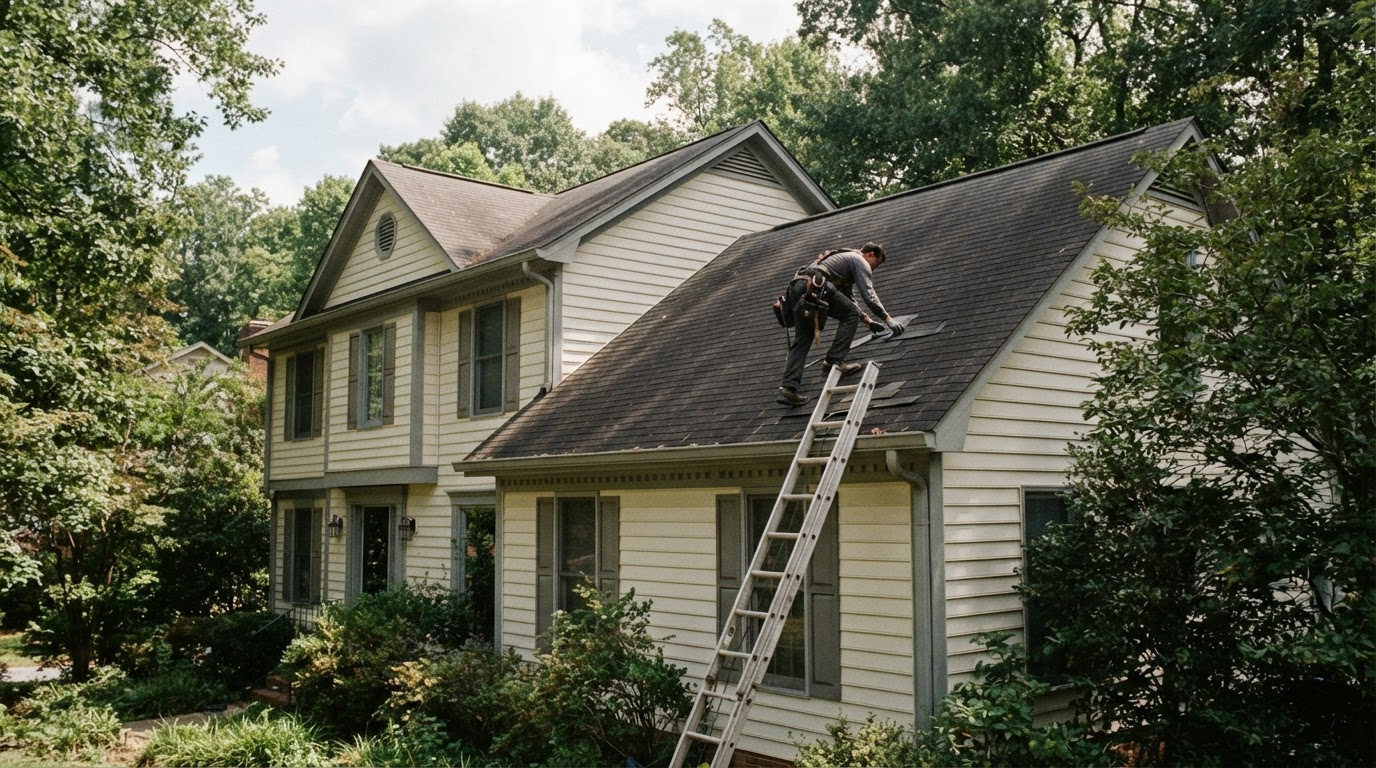
Best Roofing Materials for Humid North Carolina Climates
Why Humidity Is the Silent Enemy of North Carolina Roofs
After more than three decades of installing, repairing, and replacing roofs across central North Carolina, we can tell you the single biggest factor in how long a roof lasts here isn't wind or hail — it's humidity. Our summers bring dew points that regularly climb into the 70s, morning relative humidity that often sits in the 80 to 90 percent range, and shaded roof slopes that can stay damp for days after a storm. That relentless moisture cycle is exactly why choosing the best roofing materials for humid North Carolina climates matters more here than it does in drier corners of the country.
In this guide, we'll break down how humidity actually attacks a roof, which materials stand up to it (and why), and the five-step framework we walk through with homeowners before recommending a single product. And when you're ready for a professional opinion on your own roof, our residential roofing services team is always glad to take a look.
How Humidity Quietly Destroys a Roofing System
Most homeowners think of rain as the main moisture threat to a roof. In truth, the water you see falling is often less damaging than the moisture that lingers afterward. High humidity keeps roofing assemblies damp longer, and chronically damp materials fail in predictable ways.
What Persistent Moisture Actually Does to a Roof
Spend any time on Carolina rooftops and you'll see the fingerprints of our climate:
- Algae streaking. Those dark streaks on so many roofs across the Triangle are caused by a moisture-loving organism (Gloeocapsa magma) that feeds on the limestone filler used in asphalt shingles. It thrives wherever a roof stays damp — especially shaded, north-facing slopes.
- Mold and mildew. The EPA recommends keeping relative humidity below roughly 60 percent because mold growth accelerates above that level. Roof decks, valleys, and attic spaces that never fully dry out become ideal breeding grounds.
- Wood rot in decking and framing. Moisture that migrates past the shingles softens roof decking, rusts fasteners, and rots fascia boards long before you ever see a stain on the ceiling.
- Premature shingle aging. Repeated cycles of damp, dry, and heavy overnight dew wear down shingle edges and accelerate granule loss — and once granules are gone, UV light finishes the job.
None of this is unique to North Carolina, but the combination of long humid summers, afternoon thunderstorms, densely wooded neighborhoods, and rarely-drying air makes our roofs work harder than the identical materials installed in drier regions.
Not Every North Carolina Roof Faces the Same Humidity
Context matters when comparing options. Homes closer to the coast deal with salt air, tropical storm remnants, and the state's highest sustained humidity. Here in the Piedmont — Raleigh, Cary, Durham, Chapel Hill, Clayton, and surrounding communities — the defining challenges are pop-up thunderstorms, heavy tree canopy, and long stretches of muggy, still air between rain events. A roof tucked under mature oaks can stay damp around the clock in July, which is why two houses with identical shingles on the same street can age at completely different rates. What they share is the need for the best roofing materials for a humid North Carolina climate that their specific lot and roof design allow.
The Best Roofing Materials for Humid North Carolina Climates
With the threat defined, here's how the major roofing materials stack up against moisture, algae, and mold — based on what we've watched hold up (and fail) on real North Carolina roofs over the past 30-plus years.
1. Algae-Resistant Architectural Asphalt Shingles
Asphalt shingles remain America's most popular roof for good reasons — cost, versatility, and color selection — but not every shingle belongs on a roof in our climate. For North Carolina homes, we strongly prefer architectural (dimensional) shingles manufactured with algae-resistant granules.
Why they perform here
- Copper- and zinc-infused ceramic granules release trace amounts of metal every time it rains, inhibiting the organisms behind black streaks before they take hold.
- The heavier fiberglass-based mat in architectural shingles resists the curling and delamination that thin 3-tab products develop in humid conditions.
- All the organic material that algae feeds on — the old organic-mat shingle era — is gone; modern fiberglass mats give the organisms almost nothing to consume once the surface granules are doing their job.
- Quality architectural lines commonly carry wind ratings in the 110–130 mph range when installed correctly — valuable in a state that sees named storms most years.
What to insist on
- The algae-resistance designation (often marked "AR") — on many product lines the upgrade adds little to the installed cost.
- Synthetic underlayment instead of traditional felt, which performs far better when humidity tries to wrinkle and degrade the deck covering.
- Self-adhering water barrier at eaves, valleys, and penetrations — exactly where wind-driven rain finds its way in first.
One honest caveat: algae-resistant granules protect the shingle surface. They cannot overcome a hot, damp attic caused by poor ventilation — which is a big reason our five-step framework below starts with airflow, not products.
2. Standing Seam Metal Roofing
If asphalt is the value play, standing seam metal is the long-game play — and in our experience it's one of the most humidity-proof materials you can put over a living space:
- Nothing to feed on. Metal is non-porous, so algae, mold, and rot have no organic material to consume. What looks like staining is usually pollen or dirt that rain rinses away.
- Fast water shedding. Smooth panels with concealed fasteners move water quickly and dry fast after storms.
- Built-in corrosion protection. Quality standing seam systems use galvanized or aluminum-zinc (Galvalume-type) coated steel with paint finishes engineered to resist rust and chalking for decades — provided edges, cut ends, and flashings are detailed properly at installation.
- Longevity. Well-installed metal roofs commonly serve 40–70 years, often outlasting the next two owners of the house.
- Bonus in our climate: reflective metal surfaces keep attic temperatures down, which reduces the heat-and-moisture cycling that ages shingle roofs from below.
The trade-offs are cost and craftsmanship sensitivity. A metal roof magnifies an installer's mistakes, so panel quality, clips, and sealant details matter as much as the product you pick.
3. Synthetic Slate and Composite Shake
Homeowners love the look of shake and slate but rightfully worry about moisture. Premium polymer and composite alternatives solve most of it: they contain little to no organic material, so they don't absorb water, host moss, or feed algae. Many products in this category also carry high impact ratings and 50-year manufacturer warranties — a strong indication of how these materials are expected to age. They weigh dramatically less than natural stone, so most existing roof structures can support them without framing upgrades.
4. Clay and Concrete Tile
Fired clay is one of the oldest roofing materials on earth for a reason — it shrugs off water. Tile performs superbly in humid climates and commonly lasts 50 years or more. The detail that matters most, though, isn't the tile: on a tile roof, the underlayment does the waterproofing while the tiles shed the bulk of the rain. A premium tile installed over bargain underlayment is a future repair bill. Budget for an underlayment replacement at some point in the tile's life, and have your framing's load capacity verified before committing to the weight.
5. Natural Slate
Natural slate is the gold standard for moisture resistance — dense, non-porous stone with a service life that can exceed a century. For most budgets it's simply overkill, and its weight demands a structural review. Where slate does appear on older, high-end North Carolina homes, the real risk isn't the stone; it's finding a roofer with the specialized experience to flash and repair it correctly.
Materials We Recommend With Caution in Our Climate
- Bare-bones 3-tab shingles. Advertised as the budget option, they tend to deliver the short end of their lifespan range in humid conditions — often 15–20 years rather than more, especially under tree shade.
- Untreated cedar shake. Wood absorbs moisture. In the cooler, drier western part of the state cedar can do fine; here it cups, cracks, and grows moss unless meticulously maintained — and even then it's a high-commitment roof.
- Thin, bargain metal panels. Light corrugated products with basic paint finishes can chalk and peel surprisingly fast under the one-two punch of our strong summer sun and constant humidity.
Humidity Resistance at a Glance: Roofing Material Comparison
Every home and budget is different, but this table sums up how the leading options perform in our climate. Lifespan ranges reflect typical service in a humid climate with a proper installation — not the optimistic maximums printed in manufacturer brochures.
| Material | Humidity & Algae Resistance | Typical NC Lifespan | Relative Cost | Best For |
|---|---|---|---|---|
| 3-tab asphalt shingles | Fair | 15–20 years | $ | Short-term holds and rental properties |
| Algae-resistant architectural shingles | Good | 22–30 years | $$ | Best overall value for most homes |
| Standing seam metal | Excellent | 40–70 years | $$$ | Long-horizon owners and energy-conscious builds |
| Synthetic slate / composite shake | Excellent | 40–50+ years | $$$ | Premium look without the weight |
| Clay / concrete tile | Excellent | 50+ years | $$$$ | Mediterranean and Spanish-style homes |
| Natural slate | Outstanding | 75–100+ years | $$$$$ | Historic and high-end properties |
Our 5-Step Framework for Choosing the Right Material for a Humid Climate
Product brochures tell you what a material can do. Your house tells you what it should do. This is the same sequence we use when advising homeowners across our North Carolina service area.
Step 1: Map your exposure. Walk outside and look up. Note which slopes get direct sun and which stay shaded, how much tree canopy hangs over the roof, its pitch, and its valley count. Shaded, valley-heavy, or lower-slope roofs need materials and flashing details tuned for damp conditions.
Step 2: Audit attic ventilation before anything else. Model building codes generally call for roughly 1 square foot of net free ventilation for every 300 square feet of attic space, split between intake (soffit) and exhaust (ridge). Most of the older homes we inspect fall short, which traps humid air against the roof deck. Fixing airflow extends the life of whichever material you install.
Step 3: Spec the moisture system under the surface. Shingles get all the attention, but the underlayment, water barriers, drip edge, flashing, and gutters are what stop wind-driven rain. Synthetic underlayment and self-adhering membrane at vulnerable areas are non-negotiable in our climate.
Step 4: Run the cost-per-year math. As a simple illustrative example: if a premium material costs about twice as much installed but lasts roughly three times as long, its annualized cost comes out lower — and you skip an entire re-roofing disruption along the way. Sticker price alone is the worst way to choose a roof where humidity is the enemy.
Step 5: Match the material to your home, HOA, and timeline. Check neighborhood architectural guidelines, confirm what your structure can carry (especially with tile and slate), and be honest about how long you'll stay in the home. Then get an on-roof inspection from a local contractor who works in this climate daily — a recommendation built from a driveway photo is worth exactly what it costs.
Don't Overlook the Roof's Support Team: Gutters and Ventilation
The best roofing material for a humid climate still underperforms when water isn't managed around it. Two systems matter more here than most homeowners realize:
- Gutters. A single intense Piedmont thunderstorm can drop inches of rain in under an hour, and your roof collects all of it. Undersized, leaking, or clogged gutters let water pour behind the fascia and wick into the soffits, decking, and even interior walls. Properly pitched seamless gutter installation sized to your roof's runoff area is part of the roofing system, not an accessory.
- Gutter protection. Pine needles and oak leaves — abundant in our neighborhoods — clog gutters quickly, and standing water in a gutter pushes moisture into the eaves night after night. Quality gutter guards keep water moving and the eaves drying.
Pair clear, free-flowing gutters with balanced soffit-and-ridge ventilation and you've eliminated the two biggest moisture traps on any North Carolina home.
Warning Signs Your Roof Is Losing the Battle Against Moisture
Humidity damage is gradual, and catching it early is the difference between a minor repair and a full replacement. Call in a professional if you notice any of the following:
- Dark streaks spreading across shaded slopes
- Granules collecting in gutters or at downspout outlets
- Shingle edges curling, cupping, or lifting
- Moss or algae clumps holding moisture against the surface
- Soft, spongy, or deteriorating fascia and soffit boards
- A musty smell in the attic or visible darkening on the underside of the roof deck
- Ceiling stains that return after every heavy rain
Frequently Asked Questions
What is the most humidity-resistant roofing material?
Standing seam metal and natural slate lead the pack because both are non-porous and give algae, mold, and rot nothing to feed on. For most budgets, though, algae-resistant architectural asphalt shingles deliver the best balance of humidity performance and value — which is why they remain our most common recommendation for homes in humid North Carolina climates.
Are the black streaks on my roof algae, and do they actually cause damage?
Usually, yes — Gloeocapsa magma, a moisture-loving organism that thrives on damp shingles. Its immediate effect is cosmetic, but those streaks are a signal that your roof is staying wet, and it slowly consumes the limestone in the shingle itself. A chronically algae-covered roof ages faster than a dry one, which is why algae-resistant granules became the industry's standard fix.
How long should an asphalt shingle roof last in North Carolina?
In our humid climate with good ventilation and quality installation, architectural shingles typically serve 22–30 years, while basic 3-tab products often land in the 15–20 year range. Heavy tree shade, poor attic airflow, and perpetually clogged gutters can shorten those numbers considerably.
Do metal roofs rust in a humid climate?
Not when they're made from properly coated steel and installed correctly. Modern standing seam systems rely on galvanized or aluminum-zinc coatings and durable paint finishes engineered to resist corrosion for decades. Problems almost always trace back to unsealed cut edges, mismatched metals in contact, or thin bargain panels — another reason installer quality matters as much as the material itself.
How often should I have my roof inspected in a humid climate?
Once a year is the baseline we recommend for local homes — spring or fall works well — plus an extra look after any major storm. An annual inspection catches spreading algae, failed flashing, lifted shingles, and gutter problems while they're still inexpensive to fix.
The Bottom Line: Choose for Moisture First, Style Second
Three decades of roofs across this state have taught us one lesson above all: in North Carolina, moisture tolerance isn't a nice-to-have feature — it's the foundation of a long-lasting roof. When you compare the best roofing materials for humid North Carolina climates, put algae resistance, drying speed, and a quality underlayment system ahead of color swatches and curb appeal, then let style break the tie between your finalists.
If you'd like experienced eyes on your roof — or straight answers about whether repair, replacement, or a different material makes sense for your home — we're here to help. Schedule a roof inspection with our team and we'll walk the roofline, check your attic ventilation, and give you an honest assessment backed by more than 30 years of working under Carolina skies.