
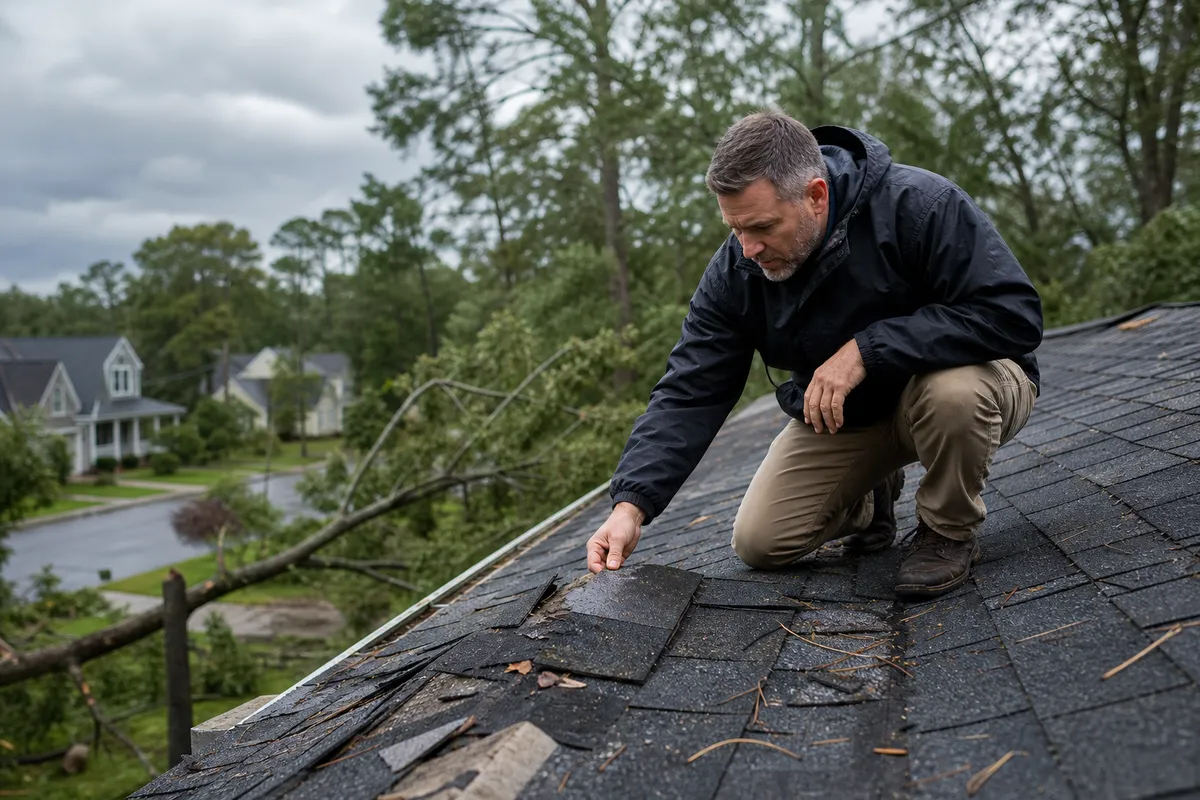
Common Signs of Storm Damage on NC Roofs: A Local Guide
After more than three decades of protecting homes across central North Carolina, we can tell you which sentence costs homeowners the most money after a severe storm: “It looks fine from down here.” The common signs of storm damage on NC roofs are rarely dramatic. Shingles don’t peel away in cinematic sheets — they crease, bruise, and lift in ways you can’t spot from the driveway, and every week that passes can turn a simple repair into a much larger claim. Whether you’re in Cary, Clayton, or anywhere from Apex to Dunn (here’s the full list of communities we serve), this guide walks you through exactly what to look for after hail, wind, and heavy rain — and what to do in the critical first days.
North Carolina roofs live some of the hardest-working lives in the country. Our state sits where warm, moist Atlantic and Gulf air collides with cooler continental air, which means a long severe-thunderstorm season, tropical systems that push well inland, hail events most springs, and freeze-thaw cycles every winter. This guide is built on what we actually see on Triangle-area roofs after major weather — not generic national advice.
Why North Carolina Roofs Take a Beating
Most states face one or two dominant roof threats. North Carolina faces nearly all of them:
- Severe thunderstorms. Damaging straight-line winds and hail are most common from late spring through early fall.
- Tropical systems. Hurricanes and tropical storms don’t have to make landfall here to matter — storms like Fran, Floyd, Matthew, and Florence all hammered inland communities, including the Triangle, with wind and flooding rain.
- Hail. Spring and early-summer hailstorms regularly roll through the Piedmont, and even modest hail can dramatically shorten a shingle’s life.
- Freeze-thaw cycles. Winter’s repeated freezing and thawing works small cracks open and breaks the seals around flashing, vents, and pipe boots.
The result is that “storm damage” here isn’t a single event type — it’s a category. And each category leaves its own fingerprint on the roof.
The Most Common Signs of Storm Damage on NC Roofs
Use the breakdown below as your field guide. We’ve organized the signs by storm type because that’s how insurance adjusters evaluate damage, too.
Wind Damage: Creased, Lifted, and Missing Shingles
Wind rarely rips a healthy shingle straight off the deck. More often it does quieter damage that shows up months later:
- Creased shingles. A fold or bend line across the shingle face, usually at or near the nailing strip. A creased shingle has a broken seal and will eventually crack and shed.
- Lifted shingles. Some shingles flap in the wind and settle back looking almost normal. If the edge flexes up easily and the seal line looks broken, the shingle is compromised.
- Missing tabs. Half-shingles gone from ridge caps, edges, and corners — the zones where wind pressure is strongest.
- Exposed underlayment or mat. A black or gray patch where the shingle surface used to be.
Wind damage concentrates on windward slopes, ridgelines, hips, and corners, so those are the first places an experienced inspector looks.
Hail Damage: Bruises, Dents, and Granule Loss
Hail leaves one of the most misunderstood signatures in roofing:
- Bruised shingles. A fresh hail bruise feels soft and spongy — like a bruised apple — often with a dark spot where granules were crushed into the mat.
- Sudden granule loss. After a hailstorm, gutters and downspout splash pads often fill with coarse, sand-like granules. Some shedding is normal on a newer roof; heavy shedding right after a storm is not.
- Dented soft metals. Hail dents aluminum flashing, gutter faces, and vent caps. Inspectors use these as corroborating evidence because metal dents are easier to see than shingle bruises.
- A random pattern. Hail hits scattered, random spots. Uniform wear — the same pattern repeated across one slope — is aging, not hail, and adjusters know the difference.
Why Hail Damage Often Doesn’t Leak Right Away
Here’s the part most homeowners miss: a hail bruise frequently holds through several rain events. What it actually does is strip protective granules, exposing the asphalt mat to UV light. The mat degrades over the following months, cracks, and then the leak appears — sometimes a year or two after the storm, when the damage is harder to attribute and possibly outside your policy’s filing window. That’s why we recommend a professional inspection after any significant hail event, even if your ceiling looks perfect.
Water Intrusion: Stains, Drips, and Attic Clues
By the time water shows up inside, it has already traveled. Watch for:
- Brown rings or stains on ceilings and walls, especially ones that grow after each rain.
- Damp attic insulation, water trails on the underside of the roof deck, or daylight around penetrations.
- A musty smell in the attic — often the first clue before any visible stain.
- Drips that start hours after the rain stops. Water entering at a damaged shingle or flashing can travel along rafters before appearing indoors, which is why the stain is almost never directly below the entry point.
Collateral Damage: Gutters, Flashing, and Falling Limbs
Some of the clearest storm evidence isn’t on the shingles at all:
- Gutter damage. Dents, sagging runs, sections pulling away from the fascia, or downspouts dumping water against the foundation.
- Bent or separated flashing at chimneys, valleys, skylights, and step walls — one of the top leak sources we find after windstorms.
- Impact punctures or crushed ridge vents from fallen limbs and wind-blown debris.
- Debris dams in valleys that force water sideways under shingles.
Gutter problems deserve special attention because they cause secondary damage fast — fascia rot, siding stains, and foundation issues. If a storm bent or detached your gutters, have them addressed in the same visit as the roof inspection.
Storm Damage at a Glance: What to Look For and How Urgent It Is
| Storm Type | Signature Signs | Where to Look | Urgency |
|---|---|---|---|
| Straight-line winds | Creased or lifted shingles, missing tabs, damaged ridge caps | Windward slopes, ridges, corners | Inspect within days — creases fail over time |
| Hail | Bruised shingles, granule piles in gutters, dented soft metals | Whole roof (random pattern), gutters, vents, flashing | Document quickly; file within your policy’s window |
| Heavy rain | Ceiling stains, wet attic insulation, drips after rain ends | Attic, ceilings, chimneys and skylights | Immediate if there’s an active leak |
| Fallen limbs / debris | Punctures, crushed vents, dented gutters, debris in valleys | Roof deck, ridge vent, gutters | Immediate — punctures leak on every rain |
| Freeze-thaw | Cracked seals, popped nails, separated flashing | Flashing, vents, pipe boots | Before spring storm season arrives |
The 20-Minute Ground-Level Self-Check
After any significant storm, you can gather solid evidence without setting foot on a ladder:
- Walk the full perimeter. Look up at the roof edges — missing shingles, lifted tabs, and damaged ridge caps usually show at edges and corners first.
- Check the gutters and downspouts. Piles of coarse granules, dented gutter faces, or a downspout that has pulled loose all point to a storm event above.
- Scan with binoculars. From the ground, look for creases, black mat exposure, and dented vent caps. You’re not diagnosing — you’re building a dated record.
- Look around the yard. Shingle tabs, flashing pieces, or large limb debris on the ground tell the story of what hit the roof.
- Check the attic and ceilings. With a flashlight, look for damp insulation, water trails on the decking, and any new stains indoors.
Safety First: Why We Recommend Staying Off the Roof
Wet shingles are slick, storm-weakened decking can be soft underfoot, and ladder mishaps are one of the most common injuries after severe weather. There’s also a documentation angle: adjusters take professionally documented findings far more seriously than smartphone photos from an untrained eye. Your job after a storm is to notice and record — leave the climbing to a crew with the right equipment.
What to Do in the First 48 Hours After a Storm
Once you’ve spotted signs of storm damage on NC roofs, the first two days shape both your repair cost and your insurance outcome:
- Photograph everything before cleanup. Yard debris, gutters, visible roof damage, interior stains — wide shots plus close-ups, with dates.
- Prevent further damage. Catch drips, move valuables, and have a professional tarp any obvious opening. Most policies expect homeowners to mitigate ongoing damage.
- Call your insurer to open a claim. Ask specifically about filing deadlines and your deductible — and note that many North Carolina coastal counties use separate percentage-based deductibles for named storms.
- Schedule a professional inspection before the adjuster visits. A contractor’s documented findings make the adjuster’s job faster and your claim stronger.
- Be cautious with door-knockers. After major storms, out-of-state “storm chaser” crews flood affected areas with high-pressure, sign-today offers — then vanish before warranty work is ever needed. Choose a company with a local address, a local track record, and a reputation it has to stand behind.
Repair or Replace? How to Decide After Storm Damage
Once damage is confirmed, the question becomes scope. Here’s how we frame the decision for homeowners:
| Factor | Repair Usually Wins | Replacement Usually Wins |
|---|---|---|
| Damage scope | A handful of shingles or one flashing zone | Widespread bruising or creasing across multiple slopes |
| Roof age | Under roughly 15 years, with plenty of service life left | Near the end of its design life — most architectural shingles run about 20–30 years |
| Cost | Lower upfront cost | Higher upfront, but better long-term value when damage is extensive |
| Insurance | Small partial claim | Often a full-replacement claim when damage is storm-caused and extensive |
| Long-term plan | You plan to keep the current roof for years | Repeated repairs are starting to stack up |
If your roof is both storm-damaged and near the end of its life, replacement is usually the smarter investment — and if budget timing is the obstacle, ask us about roof financing options that let you replace on your schedule rather than the storm’s.
What a Professional Storm Inspection Actually Includes
A proper inspection is far more than a glance from a ladder. When our residential roofing team inspects a storm-damaged home, the process looks like this:
- Full exterior walk. Every slope, valley, ridge, and penetration checked for creases, bruises, missing material, and soft-metal dents.
- Hail assessment by the industry-standard method. Inspectors mark out test squares across the roof to count and confirm hail strikes — the same approach adjusters use.
- Flashing and penetration review. Chimneys, skylights, pipe boots, and step flashing — the leak sources most ground checks miss entirely.
- Attic and interior check. Decking moisture, insulation condition, and interior stains traced back to their actual entry points.
- Documentation packet. Dated photos, measurements, and a written summary formatted so your adjuster can verify findings quickly.
- An honest verdict. If you don’t have damage worth claiming, we tell you that. A 30-year local reputation isn’t built on inflated claims.
Frequently Asked Questions
Will my homeowners insurance cover storm damage to my roof?
In most cases, yes — sudden damage from wind, hail, or a fallen tree is exactly what homeowners policies are designed to cover. What policies typically exclude is gradual wear, deferred maintenance, or damage that worsened because it was ignored. Details and deductibles vary by carrier and county, so review your policy or talk to your agent before storm season, not after.
How soon after a storm should I have my roof inspected?
Within a few days if possible, and immediately if you see an active leak. Beyond preventing secondary damage, timing protects your claim — insurers generally expect prompt reporting, and hail or wind evidence is easiest to verify while it’s fresh and before other weather muddies the record.
Can I spot hail damage from the ground?
Sometimes. Dented gutters, dinged vent caps, and a sudden surge of granules at the downspouts are visible clues. But shingle bruising itself generally requires close-up inspection — which is exactly why a free professional inspection after significant hail is worth the hour it takes.
My roof isn’t leaking, so can it still be storm damaged?
Absolutely. Creased shingles and hail bruises often hold through several rain events before failing. The underlayment buys time, but degraded shingles will eventually leak — typically a year or two after the storm, when the damage is harder to attribute and possibly outside your filing window.
What’s the difference between storm damage and normal wear?
Pattern and distribution. Storm damage — especially hail — shows up as random, scattered strikes across the roof, often corroborated by dents on soft metals like gutters and vents. Normal wear appears as uniform granule loss concentrated on the sun-exposed slopes, in valleys, and along foot-traffic paths. Adjusters are trained to tell the two apart, and so are we.
Protect Your Roof Before the Next Storm Hits
North Carolina will always send weather our way — that part isn’t up to us. What is up to you is catching the common signs of storm damage on NC roofs early, documenting properly, and working with a local crew that has to live with its work. For more than 30 years, MJ’s Roofing and Remodeling has inspected, repaired, and replaced storm-damaged roofs across the Triangle and beyond, and we’ve built that reputation one honest inspection at a time.
If a recent storm has you wondering about your roof — or if it’s simply been a while since anyone gave it a serious look — don’t wait for a ceiling stain to make the decision for you. Schedule your free storm damage inspection today, and let our team give you a straight answer about exactly what your roof needs.