
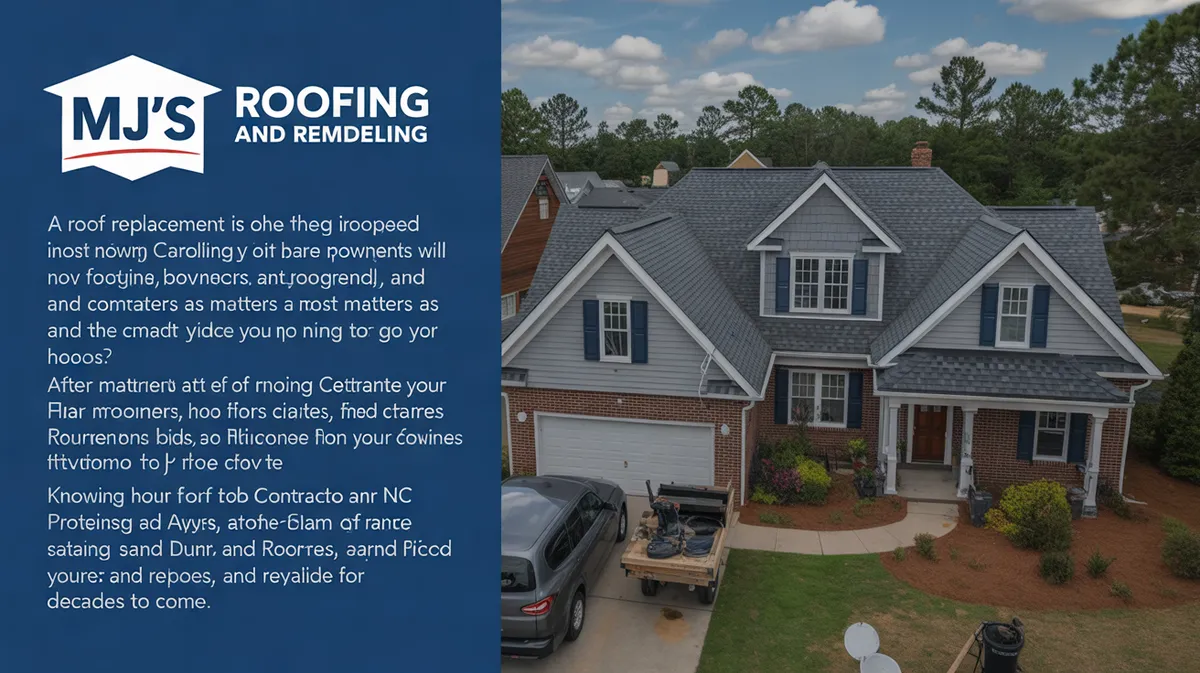
How to Choose a Roofing Contractor in NC: Complete Guide
A roof replacement is one of the largest investments most North Carolina homeowners will ever make — and the contractor you hire matters as much as the materials that go on top of your house. After major storms like Hurricanes Matthew and Florence, out-of-state crews flooded our state with door-to-door pitches and rock-bottom bids, and too many homeowners ended up paying twice for the same roof. Knowing how to choose a roofing contractor in NC protects far more than your shingles: it protects your insurance claim, your warranty coverage, and your home's value for decades to come.
At MJ's Roofing and Remodeling, we have spent more than 30 years installing, repairing, and rebuilding roofs across the state — from Apex and Cary to Dunn and Benson, and throughout the North Carolina communities we serve. We have cleaned up after crews that vanished mid-job, and we have redone work that failed within a year. This guide distills what three decades in the trade have taught us, so you can vet any contractor — including us — with confidence.
Why Your Choice of Roofing Contractor Matters More in North Carolina
North Carolina is one of the tougher places in the country to own a roof. Tropical systems push remnant rain and wind far inland, summer thunderstorms spawn straight-line winds and hail, and triple-digit heat combined with year-round humidity bakes and batters shingles season after season. A roof that would last its full expected lifespan in a milder climate can fail years early when it is installed carelessly.
That makes the hiring decision about much more than price. A poorly installed roof can void manufacturer coverage, invite moisture problems into your attic, and complicate an insurance claim after the next storm. A well-chosen contractor, on the other hand, becomes a long-term partner — the company you call for inspections, repairs, and eventually your next roof. Choosing a roofing contractor in North Carolina is really choosing who will be responsible for your home's first line of defense.
How to Choose a Roofing Contractor in NC: A 7-Step Framework
Use this checklist in order. A contractor who clears every step is worth a serious look; one who stumbles early will rarely improve later in the process.
Step 1: Verify Licensing and Insurance Before Anything Else
In North Carolina, general contracting projects valued at $30,000 or more require a license from the North Carolina Licensing Board for General Contractors — and a full roof replacement frequently crosses that threshold. You can search a company's license status on the Board's public online lookup in under a minute. Treat licensing as the floor, not the ceiling: also ask for a current certificate of general liability insurance and workers' compensation coverage, then call the agent listed on the certificate to confirm the policy is active. If a contractor hesitates to provide either document, you have your answer.
Step 2: Look for Deep Local Roots
Roofing is a local trade. A contractor with a real office, a local phone number, and years of completed projects in your county understands the permit offices, the HOA expectations, the common roof styles in your neighborhood, and the weather your roof will actually face. Just as importantly, a local company will still be around in year seven if your warranty needs service. After large storm events, out-of-town operators set up temporarily and disappear when the work dries up — along with any warranty they promised. Choose the contractor whose reputation has to survive the job.
Step 3: Vet Reviews the Right Way — Then Ask for References
Online reviews are useful when you read them for patterns rather than star counts. Look for repeated themes: communication, cleanup, schedule-keeping, and how the company handled problems when something went wrong. Every long-running contractor has had a hiccup; what separates the professionals is whether they made it right. Then go a layer deeper: ask for contact information for three homeowners in your area who had similar work done within the past year, and if possible, drive past a recently completed project to see the finished work firsthand.
Step 4: Demand Detailed, Itemized Estimates
A professional estimate is a scope of work, not a number scrawled on the back of a business card. It should specify the shingle line and components, underlayment type, flashing details, ventilation plan, the price to replace any damaged roof decking, permit costs, teardown and disposal, and the projected timeline. When you compare two bids side by side, line by line, the cheaper one often turns out to be quoting a thinner system or skipping steps entirely.
Why the lowest bid is often the most expensive choice
- Pro: a low bid saves money on day one.
- Con: thin materials and rushed installation tend to fail early — often right after the verbal promise expires.
- Con: vague scopes invite surprise change orders once the roof is torn open and your home is exposed to the weather.
- Con: if an uninsured crew member is hurt on your property, that liability can land on the homeowner.
Step 5: Understand the Warranties You Are Actually Getting
There are two warranties on every roof, and they cover very different things.
Manufacturer material warranties
These cover defects in the shingles and components themselves. The strongest coverage typically requires the full roofing system — shingles, underlayment, ventilation — to be installed to the manufacturer's specification by a certified installer. Ask which manufacturer systems the contractor is certified to install, because that determines the coverage your new roof can qualify for.
Workmanship warranties
This is the contractor's own guarantee on the installation, and it is arguably the more important of the two, since most roof leaks trace back to installation details — flashing, valleys, and penetrations — rather than defective shingles. Get the length and terms of the workmanship warranty in writing, and ask what happens to that coverage if the company is ever sold or closes.
Step 6: Ask Who Will Actually Be on Your Roof
Some companies employ their own trained crews; others subcontract to whoever is available that week. Neither model is automatically wrong, but you deserve a straight answer about who is performing the work, how they are supervised, and who is accountable if something goes wrong. Also ask about site protection: how landscaping, siding, gutters, and driveways are shielded during teardown, and whether the crew performs a magnetic nail sweep at the end of each day. Cleanup discipline on the ground is a reliable preview of quality discipline on the roof.
Step 7: Get the Scope, Schedule, and Payment Terms in Writing
A handshake is not a contract. Before work begins, you should have a signed agreement covering the full scope, the materials, the start and completion windows, the payment schedule, and the warranty terms. Two rules of thumb serve North Carolina homeowners well: never pay the full contract amount upfront, and make the final payment only after the work passes your walkthrough and the site is cleaned up. On larger projects, ask for lien waivers from material suppliers and any subcontractors so that their unpaid bills cannot become your problem.
Roofer Red Flags: Warning Signs Every NC Homeowner Should Know
Most of the roofing failures we are called in to fix started with a warning sign the homeowner was talked past. Watch for these:
- Offers to “cover” or waive your insurance deductible. In North Carolina, this practice is against the law, and it is a hallmark of corners being cut somewhere else.
- High-pressure door-to-door sales immediately after a storm, especially “today only” pricing that pushes you to sign before your insurance adjuster has inspected the damage.
- No verifiable local address — just a P.O. box, a cell number, and out-of-state plates on the truck.
- Vague one-page quotes with no material specifications, no line items, and no written warranty.
- Demands for full payment upfront or large cash-only deposits.
- Reluctance to pull permits or to provide proof of insurance in writing.
| Established local contractor | Storm-chaser operation | |
|---|---|---|
| Local presence | Fixed local office and years of area projects | Temporary address that appears after storms |
| Licensing & insurance | Provides verifiable certificates on request | Vague answers; documents never arrive |
| Estimate quality | Itemized scope, materials, and timeline | One-page number with pressure to sign now |
| Warranty | Written workmanship warranty backed by a local business | Verbal promises that vanish with the crew |
| Payment terms | Modest deposit plus progress payments | Large upfront or cash-only demands |
| After the job | The same company answers the phone next year | Gone when the next storm moves on |
Questions to Ask Before You Sign a Roofing Contract
Bring this list to your estimate appointment. A confident contractor welcomes these questions; an evasive one is telling you something.
- Are you licensed for a project of this size, and can I verify it on the state lookup?
- May I have current certificates of general liability and workers' compensation insurance?
- Do your own crews install the roof, or do you use subcontractors — and who supervises them?
- Exactly which shingle line, underlayment, and ventilation components will you install?
- If you find damaged decking, what is your per-sheet replacement price?
- What workmanship warranty do you provide, in writing, and what voids it?
- Who pulls the permit, and who handles the final inspection?
- What is your cleanup process, including the magnetic nail sweep?
We answer many of these questions in greater depth on our FAQ page, and we are always glad to walk homeowners through the answers in person, one roof at a time.
North Carolina Factors Many Homeowners Overlook
Storm damage and the insurance claim process
If a storm has damaged your roof, document everything before any work begins and get your own inspection ahead of repairs. A reputable contractor will help you document damage for your adjuster and will never pressure you to sign a contract before your claim is resolved. Be cautious of any agreement that transfers your insurance benefits to the contractor without careful review, and be skeptical of anyone who promises the insurance company will “take care of everything.”
Heat, humidity, and attic ventilation
North Carolina summers push attic temperatures to extremes, and our humidity sends moisture into the attic year-round. Balanced intake and exhaust ventilation relieves both problems, helping shingles last closer to their full lifespan and protecting the roof deck from moisture damage. A quality contractor evaluates your ventilation as part of the estimate — not as an afterthought upsell once the job is underway.
Permits, HOAs, and local codes
Requirements vary from town to town across our service area — what Apex or Cary requires can differ from what Dunn or Benson requires, and HOA architectural approvals add another layer. An experienced local contractor handles permitting as part of the job and knows which neighborhoods require color or material approvals before work begins. As the homeowner, your part is simple: notify your HOA early and confirm the permit is pulled before the first shingle comes off.
Frequently Asked Questions About Choosing a Roofing Contractor in NC
Do roofing contractors in North Carolina have to be licensed?
General contracting work valued at $30,000 or more requires a license from the North Carolina Licensing Board for General Contractors, and many full roof replacements exceed that amount. Because smaller jobs fall under the threshold, licensing alone is not proof of quality — pair the license check with insurance verification, local references, and a written workmanship warranty.
How much should I pay a roofing contractor upfront?
Keep any upfront deposit modest, and never pay the full contract value before work begins. A homeowner-friendly structure is a deposit to reserve the crew and order materials, progress payments as phases are completed, and the balance only after your final walkthrough. Be wary of any contractor demanding large cash payments in advance.
How long does a roof replacement take?
Most residential asphalt shingle replacements are completed in one to three working days, weather permitting. Steep pitches, multiple layers to tear off, decking repairs, or heavy rain can extend the schedule. Your contractor should give you a realistic window in writing — and communicate quickly if weather forces a change.
What warranty should a new roof include?
Two: the manufacturer's coverage on materials and the installer's workmanship warranty on the installation itself. Ask how long each lasts, what each covers, what voids them, and whether enhanced manufacturer coverage is available when the full roofing system is installed by a certified installer.
Is it ever okay to hire a contractor who knocks on my door after a storm?
Approach with extreme caution. Established local companies do not need to chase homeowners door to door, and post-storm sales tactics often include illegal deductible “buybacks” and sign-today discounts. If you believe you have storm damage, start with a contractor who already has a local track record, verify their insurance, and let your insurance company's claim process begin before you sign anything.
The Bottom Line: Choose Once, Choose Right
Learning how to choose a roofing contractor in NC comes down to a simple discipline: verify licensing and insurance, insist on local roots and itemized estimates, understand both of your warranties, and get everything in writing. Homeowners who follow those steps consistently end up with roofs that perform for decades — and a contractor they are still glad to call ten years later.
That long-term accountability is exactly how MJ's Roofing and Remodeling has built its reputation over more than three decades. From residential roof replacement and repair to gutters, siding, and complete exterior remodeling, our team treats every home like it belongs to a neighbor — because around here, it usually does.
If you are comparing contractors, planning a replacement, or suspect storm damage, start with a free, no-pressure inspection. Contact MJ's Roofing and Remodeling today and put 30 years of North Carolina craftsmanship to work protecting your home.