
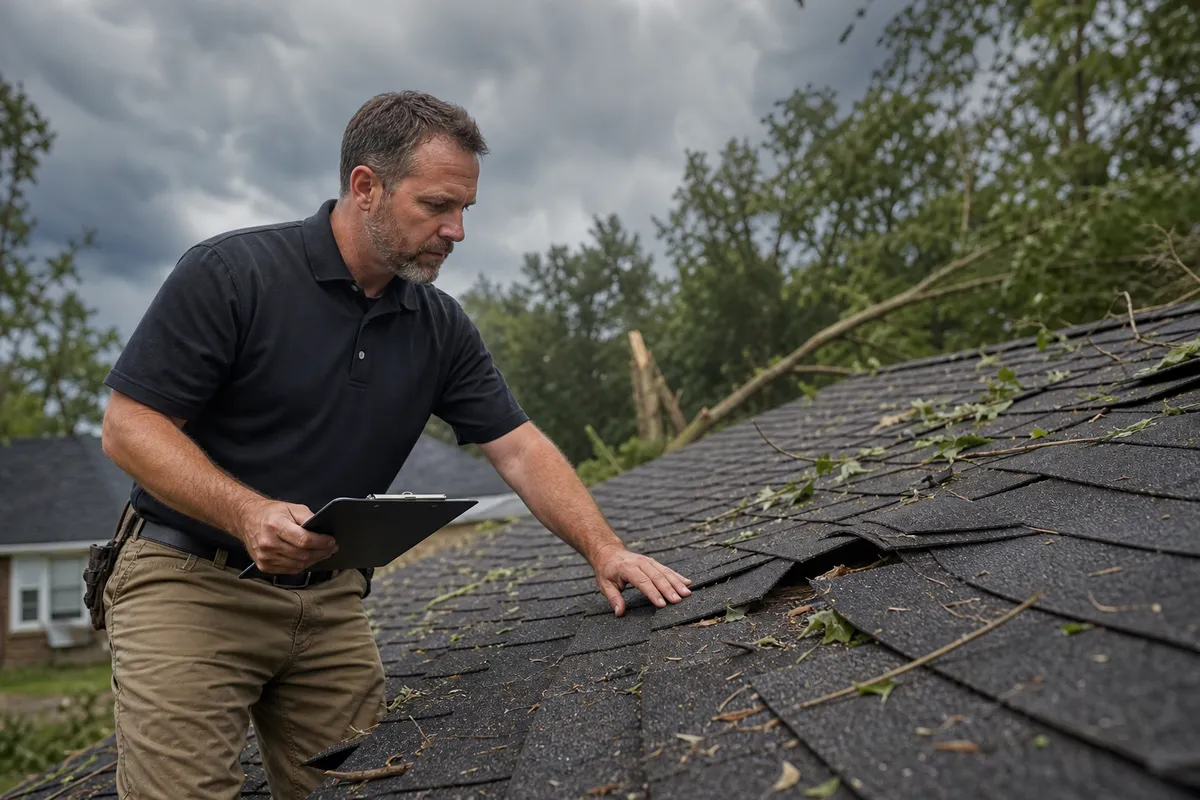
How to Identify Storm Damage on Your Roof: NC Guide
When a line of severe thunderstorms rolls across central North Carolina or a tropical system pushes inland from the coast, one of the first questions homeowners ask is simple: did my roof make it through? After more than three decades of inspecting and repairing roofs across this state, we can tell you the honest answer is often more complicated than a quick glance from the driveway suggests. Some storm damage is obvious — a bare patch of missing shingles is hard to miss — but the damage that costs homeowners the most money tends to hide in creased shingle tabs, dented flashing, and granules quietly washing into the gutters long before a stain ever appears on the ceiling.
That is exactly why knowing how to identify storm damage on your roof matters. The sooner you spot it, the sooner you can document it, file an insurance claim if one is warranted, and keep a small problem from becoming a structural one. In this guide, we are sharing the same ground-up process our crews use after major weather events, along with material-specific warning signs, the hidden trouble spots most homeowners miss, and a clear action plan for what to do next.
Why North Carolina Roofs Are Especially Vulnerable to Storms
North Carolina homeowners deal with a wider range of roof-threatening weather than most of the country. Depending on the year, our roofs face hurricanes and their remnants, severe spring and summer thunderstorm lines, hail, straight-line winds, and the occasional winter ice storm. Longtime residents remember storms like Hurricane Fran in 1996, Matthew in 2016, Florence in 2018, and Helene's devastation in western North Carolina in 2024 — reminders that significant roof damage here is a matter of when, not if.
Industry claim data backs up what we see in the field: year after year, wind and hail rank among the most common and most costly causes of homeowners insurance claims nationwide. Our climate compounds the problem, too. Hot summers, heavy humidity, and frequent rain accelerate the aging of any roof that has already been weakened, which is why storm damage left unrepaired tends to worsen faster here than in drier climates.
How to Identify Storm Damage on Your Roof: The Ground-Up Method
Before we get into specific signs, one safety rule comes first: do not climb on your roof to look for storm damage. Damaged shingles are slick, weakened decking can give way, and most post-storm homeowner injuries happen during exactly this kind of well-intentioned check. Everything below can be done from the ground and from your attic. When you need eyes on the roof surface itself, that is a job for a professional with ladders, harnesses, and trained observation — our residential roofing team performs those inspections every week.
Step 1: Walk the Perimeter and Read the Landscape
Start with a slow walk around your entire home, ideally the morning after a storm while details are fresh. You are looking for clues on the roofline and in the yard:
- Missing, lifted, or creased shingles along eaves, ridges, and valleys
- Debris — branches, shingle tabs, or pieces of flashing in the yard or resting on the roof
- Dents on soft metal surfaces such as gutters, downspouts, vent hoods, and exterior A/C units — these are classic hail fingerprints
- Damage to other exterior surfaces, including dented window screens, chipped siding, and broken fence posts, which suggest the storm hit hard enough to affect the roof
- Fallen limbs that touched the roof, even if they slid off — impact points often hide beneath where the limb struck
One telltale detail we teach homeowners: hail damage shows up as a random pattern of dents across multiple sides of the house and multiple roof slopes, while wind damage concentrates on the windward side, at edges, and along ridgelines. Reading that pattern is the first real skill in identifying storm damage.
Step 2: Inspect Your Gutters and Downspouts
Your gutter system is a natural evidence collector after a storm:
- Granule buildup. Asphalt shingles shed granules that look like coarse black sand. A heavier-than-normal accumulation after a storm — especially granules washing out at the downspout exits — suggests hail or driving rain knocked protective granules loose.
- Dents and dings. Check the faces of gutters and downspouts at different heights. A hailstorm typically leaves marks at several elevations and on more than one side of the house.
- Detached or sagging sections. Wind can pull gutters away from the fascia, and damaged gutters that overflow push water back toward the roof edge — one of the most common sources of rot we repair.
If a storm left your gutters loose, leaking, or pulling away from the fascia, fix them quickly — proper drainage is part of roof health. Our gutter installation team handles seamless gutter replacement and gutter guards for exactly this reason.
Step 3: Check the Attic Before You Ever Check the Roof
The attic tells the truth about your roof's condition. Take a flashlight up there within a day or two of heavy rain and look for:
- Water stains or dark streaks on the underside of the roof decking
- Damp, matted, or compressed insulation, which holds moisture against the wood below it
- Daylight visible around chimneys, vent pipes, or where deck boards meet — a sign of displaced flashing or separated decking
- A musty smell, which often appears before stains do
Keep in mind that interior ceiling stains can lag the actual leak by weeks or even months, so the attic is your early-warning system. A stain there today may trace back to an entry point that opened during a storm you barely remember.
Signs of Storm Damage by Roofing Material
Not all roofs fail the same way. Here is how storm damage presents on the most common roofing materials we see across North Carolina:
| Material | Common storm damage | Easy-to-miss signs |
|---|---|---|
| Asphalt shingles | Missing tabs, lifted or creased shingles, granule loss, bruised spots | Creases hidden under overlapping courses; soft bruises that look like ordinary dark spots |
| Metal panels | Dents and dimples, chipped coatings, loosened fasteners | Screws backing out; small coating cracks at hail strikes that later rust |
| Flat / low-slope membranes | Punctures from wind-blown debris, split seams, displaced edge metal | Ponding water after rain; blisters that only reveal themselves up close |
| Wood shake / tile | Cracked, split, or displaced pieces from impact and wind uplift | Hairline cracks beneath overlapping pieces; shifted tiles that still look seated from the ground |
Asphalt Shingles: The Details That Matter
Because asphalt shingles cover most North Carolina homes, they deserve a closer look. When our crews inspect a storm-hit asphalt roof, we look for:
- Granule loss in concentrated patches. A shingle surface should wear uniformly; sudden bald spots point to impact.
- Bruising. Dark, soft, slightly recessed spots where hail knocked granules free and bruised the mat underneath. A fresh bruise feels soft and may show a shiny spot at its center.
- Creased or lifted tabs. Wind gets under the shingle edge and bends it. Even if the tab reseals, the seal strip is broken, and that shingle will lift again in the next storm.
- Cracked or split shingles caused by wind flexing the shingle back and forth until the mat fractures.
Metal and Flat Roofs
Metal roofing usually outperforms shingles in high wind, but hail leaves its signature in dents and, more importantly, in chipped coatings that invite rust over time. On flat and low-slope roofs — including many commercial properties — wind-blown debris causes punctures, and lifted edge metal or flashing is the most common failure point. Either way, the fix starts with a proper post-storm inspection rather than an assumption that everything held up.
Wind vs. Hail vs. Water: Telling the Three Apart
Knowing which kind of storm hit your roof is more than trivia — it shapes what the damage looks like, where to look, and how an insurance claim gets evaluated.
| Damage type | Where it shows up | Telltale signs | Why the distinction matters |
|---|---|---|---|
| Wind | Windward slopes, edges, ridgelines, ridge caps | Lifted, creased, or missing shingles; broken seal strips; debris impacts concentrated on one side of the home | Often repairable slope-by-slope; the directional pattern helps confirm the storm as the cause |
| Hail | Randomly across all slopes and elevations, plus soft metals | Bruised shingles, scattered granule loss, dented vents and gutters in a random pattern | Repairs usually need to address whole slopes rather than spot patches for the roof to seal properly |
| Water / leaks | Inside the home — attic first, ceilings later | Stains, drips, damp insulation, musty odor | Water is the symptom, not the cause — the entry point must be found and fixed, not just the stain |
A practical note from experience: insurance adjusters and reputable contractors both rely on these patterns. Random dents across every elevation point to hail; damage clustered on one windward side points to wind. If someone tells you that you have hail damage but the marks appear on only one slope and nowhere on your gutters or soft metals, it is worth getting a second opinion. Honest identification protects you in both directions — from paying for repairs you do not need, and from missing damage that deserves a claim.
The Hidden Storm Damage Most Homeowners Miss
Shingles get all the attention, but in our experience the damage that becomes next season's leak usually starts somewhere else:
Flashing, Boots, and Roof Penetrations
Every chimney, vent pipe, skylight, and valley is a seam in your roof's armor. Storms bend step flashing, crack the sealant around vent boots, and lift chimney counterflashing just enough to let wind-driven rain underneath. These areas are small, nearly impossible to evaluate from the ground, and responsible for a disproportionate share of the leaks we trace. A roof can have perfectly intact shingles and still fail at a flashing detail.
Decking and Structural Damage
A heavy limb that bounces off the roof may leave no visible shingle damage but can crack or fracture the wooden decking beneath. From inside the attic, look for sagging panels between rafters or fresh splits in the wood. Outside, a subtle dip or uneven plane in the roofline deserves a professional look. Decking damage cannot be fixed from the surface — it has to be found before new shingles go over it.
Everything Else the Storm Touched
Storms rarely damage the roof in isolation. Dented fascia, cracked siding, compromised window flashing, and clogged gutters all feed moisture toward the structure. When we inspect after a storm, we look at the whole building envelope, because fixing the roof while ignoring a damaged gutter or a breached wall just moves the water problem somewhere new.
What to Do After You Spot Storm Damage: A 5-Step Action Plan
- Document everything before touching anything. Take wide photos of each side of the house, then close-ups of specific damage, with timestamps turned on. Note the date of the storm. This record is the backbone of any insurance conversation.
- Prevent further damage. Catch interior drips, and have exposed areas tarped by professionals if the roof is open to the weather. Keep receipts for any mitigation work — insurers generally expect you to protect the property, and reasonable mitigation costs are often reimbursable.
- Get a professional inspection before calling your insurer. A reputable local roofer can map the damage, distinguish storm damage from age-related wear, and give you an honest read on whether a claim makes sense — so you know your position before the adjuster ever arrives.
- File the claim and meet the adjuster with your contractor present when possible. Having the same professional who documented the damage walk the roof with the adjuster keeps everyone working from the same facts.
- Make permanent repairs promptly. In North Carolina's heat and humidity, an unrepaired roof ages fast. Moisture works into the decking, mold takes hold in the attic, and the next storm exploits every weak point. Small, timely repairs are almost always cheaper than the replacement that comes from waiting.
A word of caution on choosing help: after major storms, out-of-state "storm chaser" crews appear in affected neighborhoods overnight. Before signing anything, choose an established local company with a real address, local references, and a track record you can verify. We have spent more than 30 years protecting homes across the communities we serve throughout North Carolina, and we plan to be here long after the storm chasers move on. That accountability is built into every estimate we write.
DIY Checks vs. Professional Inspections
Both have a place in the process — as long as you understand what each one can and cannot tell you.
| DIY ground and attic check | Professional roof inspection | |
|---|---|---|
| Best for | Fast triage after a storm; catching obvious damage and active leaks | Confirming subtle damage; documenting for insurance; finding hidden entry points |
| Can it spot bruising and creases? | Rarely — these require close, trained observation | Yes — inspectors know exactly where and how impact and wind damage present |
| Safety | Safe when limited to the ground and attic | Professionals use ladders, harnesses, and trained techniques |
| Cost | Free | Often free or low-cost from established local contractors |
Frequently Asked Questions
How can I tell if roof damage came from a storm or just normal aging?
Look at the pattern and the timeline. Age-related wear is gradual and uniform — granules thin evenly, shingles curl broadly, and there is no specific weather event to point to. Storm damage is sudden and patterned: wind damage clusters on one side and along ridges, hail appears as a random scattering of dents and bruises, and debris leaves impact marks. Checking whether neighbors with similar roofs noticed damage the same weekend is another useful clue.
Will my homeowners insurance cover storm damage to my roof?
Most policies cover sudden, accidental damage from perils like wind and hail, subject to your deductible and policy terms. The details matter, though: some policies pay actual cash value on older roofs rather than full replacement cost, and in parts of North Carolina wind and hail deductibles are sometimes calculated as a percentage of dwelling coverage. Read your declarations page, and ask your roofing contractor to help you understand what the inspection found before you file — a well-documented claim is a stronger claim.
Is it safe to climb on my roof to check for storm damage?
We advise against it, strongly. Post-storm roofs combine wet surfaces, loose granules, and possibly weakened decking — a dangerous combination even for sure-footed homeowners. Everything a homeowner needs to do can be done from the ground and the attic. Roof-level inspection belongs to professionals with the right equipment and training.
How soon after a storm should I have my roof inspected?
Within a few days to a couple of weeks is ideal, and immediately if you have an active leak. Do not wait indefinitely: many policies include time limits for filing storm-related claims, so a delayed inspection can complicate a claim that would otherwise have been straightforward. Early inspection also catches damage while repairs are still small.
Can a roof look fine from the ground and still have serious storm damage?
Yes — and it happens more often than you might think. Bruised shingles, creased tabs hidden under overlapping courses, bent flashing behind a chimney, and small punctures on flat roofs are all invisible from the driveway. That gap between what you can see and what is actually there is the single best argument for a professional inspection after any significant storm.
The Bottom Line: Catch Storm Damage Before It Catches You
Learning how to identify storm damage on your roof is one of the most valuable maintenance skills a North Carolina homeowner can develop. Walk the perimeter after every major storm, let your gutters and attic tell you what the roofline hides, understand the difference between wind, hail, and water damage, and bring in a professional before small problems become structural ones. Thirty years of storms have taught us that the homes that fare best are not the ones that avoided damage — they are the ones whose owners caught it early.
If a recent storm has you wondering about your roof — or if it has simply been a while since anyone took a close look — we are here to help. A professional inspection costs you nothing but peace of mind gained. Contact MJ's Roofing and Remodeling today to schedule your free storm damage inspection, and let three decades of local craftsmanship and care go to work protecting your home.