
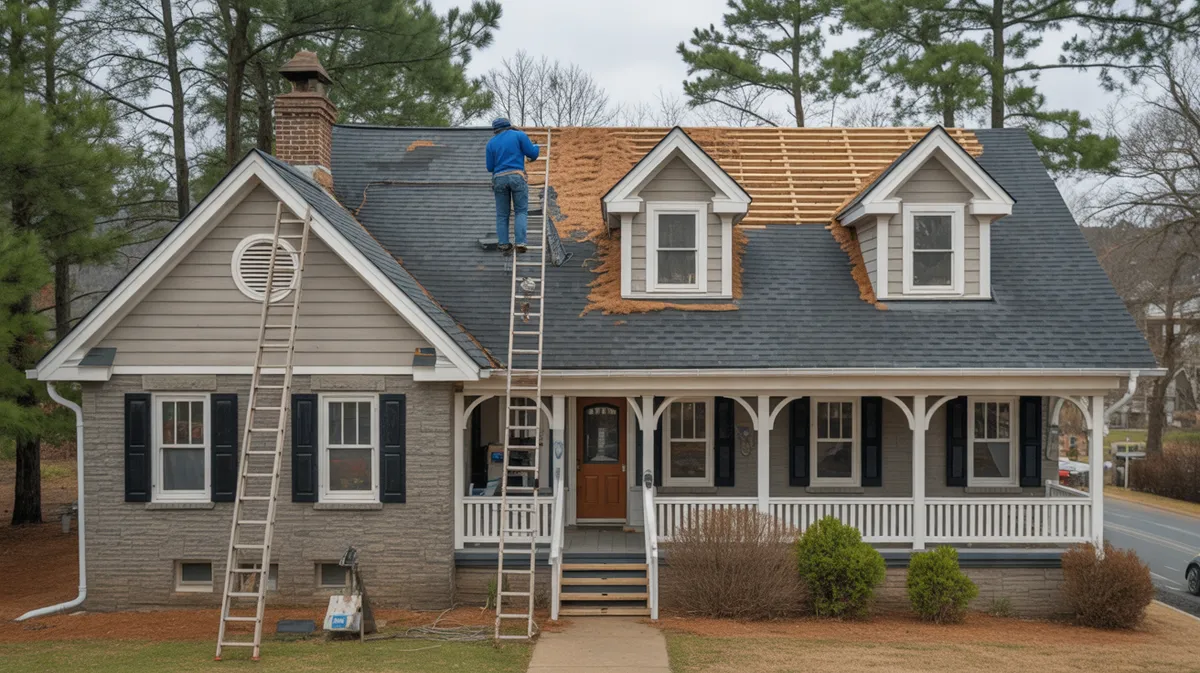
9 Signs You Need a Roof Replacement in North Carolina
After more than three decades of climbing ladders across North Carolina — from the pine-lined neighborhoods of the Triangle to the rural communities of Harnett and Johnston counties — we've noticed one thing that never changes: homeowners almost never catch roof failure early. Not because they aren't paying attention, but because the signs you need a roof replacement in North Carolina rarely announce themselves with a dramatic leak. They show up quietly — a handful of granules in the gutter, a shingle tab that lifts in the afternoon sun, an energy bill that creeps up every summer.
This guide is the same walkthrough we give homeowners during an inspection. Below, you'll find the nine warning signs we see most often in our climate, a practical framework for deciding between repair and full replacement, and a 15-minute DIY check you can do this weekend. By the end, you'll know what to look for, what it means, and when it's time to bring in a professional. If you'd like a baseline first, our residential roofing services page explains exactly what a full professional inspection covers.
Why North Carolina Roofs Wear Out Faster Than the Brochure Says
Shingle manufacturers rate their products under controlled lab conditions that look nothing like a July afternoon in the Piedmont. North Carolina sits in a humid subtropical climate, which means your roof deals with a combination of stressors that few other regions pack into a single year.
| NC weather factor | What it does to your roof | Early warning to watch for |
|---|---|---|
| Intense summer heat and UV exposure | Bakes the oils out of asphalt shingles, making them brittle | Curling edges; shingles that crack when pressed |
| Afternoon thunderstorms and hail | Knocks granules loose, bruises shingles, cracks sealant strips | Sand-like granules collecting in gutters after storms |
| Hurricane season, June through November | Lifts shingles in high wind and drives rain under flashing | Water stains that appear only after major storms |
| Year-round humidity and pine straw | Feeds algae and moss and traps moisture against the deck | Dark streaks and debris dams in valleys and at eaves |
| Occasional winter freeze-thaw cycles | Pops nails and cracks caulking and flashing seals | Raised shingle tabs; attic drips after cold snaps |
The takeaway: a shingle rated for three decades in a mild climate may need serious attention well before that here. Heat, moisture, and wind are the three conditions asphalt shingles handle worst — and North Carolina serves up all three in abundance.
The 9 Signs You Need a Roof Replacement in North Carolina
1. Curling, Cracking, or Missing Shingles
Cupping (edges turning upward) and clawing (edges flattening while the middle bulges) are the classic signatures of heat stress, and our summers accelerate both. A few scattered tabs lifting after a storm points to wind uplift. But when lifted, cracked, or missing shingles appear across large sections — or come back every season after every storm — the sealant strips have failed systemically. At that stage, you're maintaining a roof that has already made its decision.
2. Granules Piling Up in Your Gutters
Those gritty ceramic granules are the shingle's sunscreen. It's normal for a brand-new roof to shed some extras, but heavy accumulation after every thunderstorm — paired with bald, darker patches where shingles look shiny — means the protective layer is failing. On a roof past its mid-teens, widespread granule loss usually means the shingles are in their final stretch.
3. A Sagging Roofline
Stand at the curb and look across the ridge: it should be straight and true. A dip along the ridge or sagging between rafters can indicate saturated decking or a structural problem, and it's the one sign on this list we treat as urgent. Don't walk on a sagging roof to investigate — keep off it entirely and get a professional eyes-on as soon as possible.
4. Water Stains, Peeling Paint, and Musty Odors Indoors
Brown ceiling stains, paint peeling near the eaves and soffits, or a persistent damp smell all point to moisture getting in somewhere above. Remember that water travels: it moves along the decking and rafters before it finally drips, so the stain is rarely directly below the entry point. One stain after a hurricane is worth investigating; recurring stains in multiple rooms point to system-wide failure rather than a single hole.
5. Daylight or Moisture in the Attic
On a sunny day, switch off the attic lights and look up. A pinpoint of daylight around a vent pipe or chimney is common; daylight showing between roof boards or across broad areas is not. While you're up there, check the insulation for damp, matted patches and look for rusty nail tips poking through the sheathing — both signal chronic condensation and ventilation problems that shorten a roof's life.
6. Moss, Algae, and Plants Growing on the Roof
Algae streaks vs. moss: what each one tells you
Dark streaks running down the shingles are algae — common in humid North Carolina and mostly a cosmetic issue. Moss is different: it roots into the shingle surface, holds moisture against it, and lifts the edges, quietly accelerating decay. And if you ever find seedlings or small plants sprouting from the gutters or roof valleys, that means debris and granule buildup has gotten deep enough to support soil — a hallmark of an advanced-age roof. Gentle cleaning handles early moss; growth that returns every season on an older roof usually supports replacement.
7. Rising Energy Bills and Rooms That Won't Cool
Worn shingles, tired underlayment, and unbalanced attic ventilation work together to push attic temperatures sky-high in July and August. Your air conditioner runs longer, upstairs rooms never quite cool off, and the bill climbs. A full replacement lets us correct ventilation at the same time — one of the most overlooked benefits of a new roof system.
8. Your Roof Is 20+ Years Old — or You Inherited It
Most asphalt shingle roofs are built to serve roughly 20 to 30 years, and North Carolina's heat and humidity tend to trim the top of that range. If you bought your home without any roof records, check your closing paperwork or your county's permit records. Whatever the number, plan the replacement on your calendar rather than the roof's — a scheduled project is almost always smoother and less costly than an emergency one.
9. Fresh Storm Damage After Hail or High Wind
After a spring hailstorm, a severe summer thunderstorm, or a tropical system, walk the perimeter and look for creased or bruised shingles, dented vent caps and gutters, lifted tabs, and fresh granule piles at the downspouts. Document everything with date-stamped photos before moving debris. Storm damage and age-related wear look different to a trained eye, and that distinction matters to insurers — a professional inspection creates the paper trail you'll want if a claim is involved.
Repair or Replace? A Practical Decision Framework
When homeowners ask us whether their roof can be saved, we weigh three things: the age of the roof, the extent of the problem, and what's happening underneath the shingles.
| Situation | Better fit | Why |
|---|---|---|
| A few wind-lifted shingles on a roof under 10 years old | Repair | The failure is localized; the system is still healthy |
| Widespread curling and granule loss on a 20+ year roof | Replace | The shingles are aging everywhere, not just where you can see |
| A leak traced to one flashing point or vent boot | Repair | A targeted fix solves it without disturbing sound shingles |
| Multiple leaks or soft, spongy decking | Replace | Deck and underlayment problems extend beyond any single spot |
| A third repair visit for the same recurring problem | Replace | Patch costs add up; a new system resets the clock entirely |
When repair makes sense
Pros: lowest upfront cost, fast turnaround, and a smart choice for isolated damage on an otherwise young roof. Cons: it doesn't fix system-wide aging, matching older shingles is difficult, and repeated patches on an aging roof mean paying into something you'll replace anyway.
When replacement makes sense
Pros: a full manufacturer warranty, uniform appearance, corrected decking and ventilation, and real value when it's time to sell or file an insurance claim. Cons: a larger upfront investment — which is exactly why we walk homeowners through the roof replacement financing options available before anyone commits to anything.
A 15-Minute DIY Roof Check You Can Do This Weekend
Safety first: keep both feet on the ground or in the attic. A pair of binoculars and a flashlight will do most of the work, and they'll do it safely.
- Walk the perimeter. Check that the ridgeline is straight, look for lifted or discolored shingles along the eaves, and eyeball the flashing where the roof meets the chimney and vent pipes.
- Check the gutters and downspouts. Look for granule piles, shingle fragments, and pine straw dams that hold moisture against the roof edge.
- Visit the attic on a sunny day. Kill the lights and scan for daylight, water stains on the sheathing, and damp or matted insulation.
- Sweep the interior after the next heavy rain. Check ceilings, the top corners of rooms, window sills, and around any skylights.
- Photo-log anything suspicious. Date-stamped photos build a history of your roof and become valuable evidence if a storm ever damages it.
If two or more of the nine signs above show up during your check, stop diagnosing and get a professional opinion — the inspection costs you nothing but an hour of your time.
Timing Your Replacement Around North Carolina's Storm Seasons
Hurricane season runs from June through November, and spring brings the hail-producing thunderstorms. That shapes the smartest windows for a planned replacement: late winter and early spring let you beat the seasonal rush and head into storm season with a new roof overhead, while fall offers mild installation weather before winter sets in. If a storm has just damaged your roof, the order flips — emergency tarping and documentation come first, then the insurance conversation, then the permanent repair. And whether you're in Cary, Durham, Dunn, or anywhere between, you can see every community we cover on our North Carolina service area page.
Frequently Asked Questions About Roof Replacement in North Carolina
How long should a roof last in North Carolina?
General industry ranges put basic three-tab asphalt shingles around 20 years and thicker architectural shingles in the 25-to-30-year range, with metal lasting considerably longer. Our heat and humidity tend to shave those numbers, which is why attic ventilation and routine maintenance matter more here than almost anywhere else.
Is it worth repairing a 20-year-old roof?
Usually only when the damage is isolated and clearly defined — a single flashing failure, for example. As a rule of thumb, if the repair estimate starts approaching a meaningful share of replacement cost on a roof past 20 years, replacement is the better long-term investment.
Will homeowners insurance pay for a roof replacement?
Insurance typically covers sudden, accidental damage — hail, wind, a fallen limb — but not gradual wear and age. Document damage immediately with dated photos, request a professional inspection, and review your own policy, since deductibles and roof-age provisions vary by carrier.
Can you replace a roof during a North Carolina winter?
Yes. Our winters are mild enough for installation most days of the season, and experienced crews take simple cold-weather precautions with sealants and materials. Off-season scheduling can also mean more flexible dates on the calendar.
How do I tell storm damage apart from normal aging?
Pattern is the giveaway. Storm damage is abrupt and localized — creases, bruises, and lifted tabs that appeared after a specific date. Aging is gradual and uniform across the whole roof. A professional inspection paired with your photo log settles the question quickly.
The Bottom Line: Don't Wait for the Ceiling Stain
North Carolina's climate is genuinely hard on roofs, and the signs you need a roof replacement in North Carolina are visible on the surface long before water ever finds your living-room ceiling. Curling shingles, gutter granules, attic daylight, a roof past 20 years — none of these fix themselves, and every one of them gets more expensive with time.
For more than 30 years, MJ's Roofing and Remodeling has protected homes across central North Carolina with quality craftsmanship and straight answers. If your roof is showing its age — or you spotted two or more signs on this list — let us take a look. Schedule a free roof inspection and we'll give you an honest assessment of what your roof needs now, what it will need later, and what it doesn't need at all.