
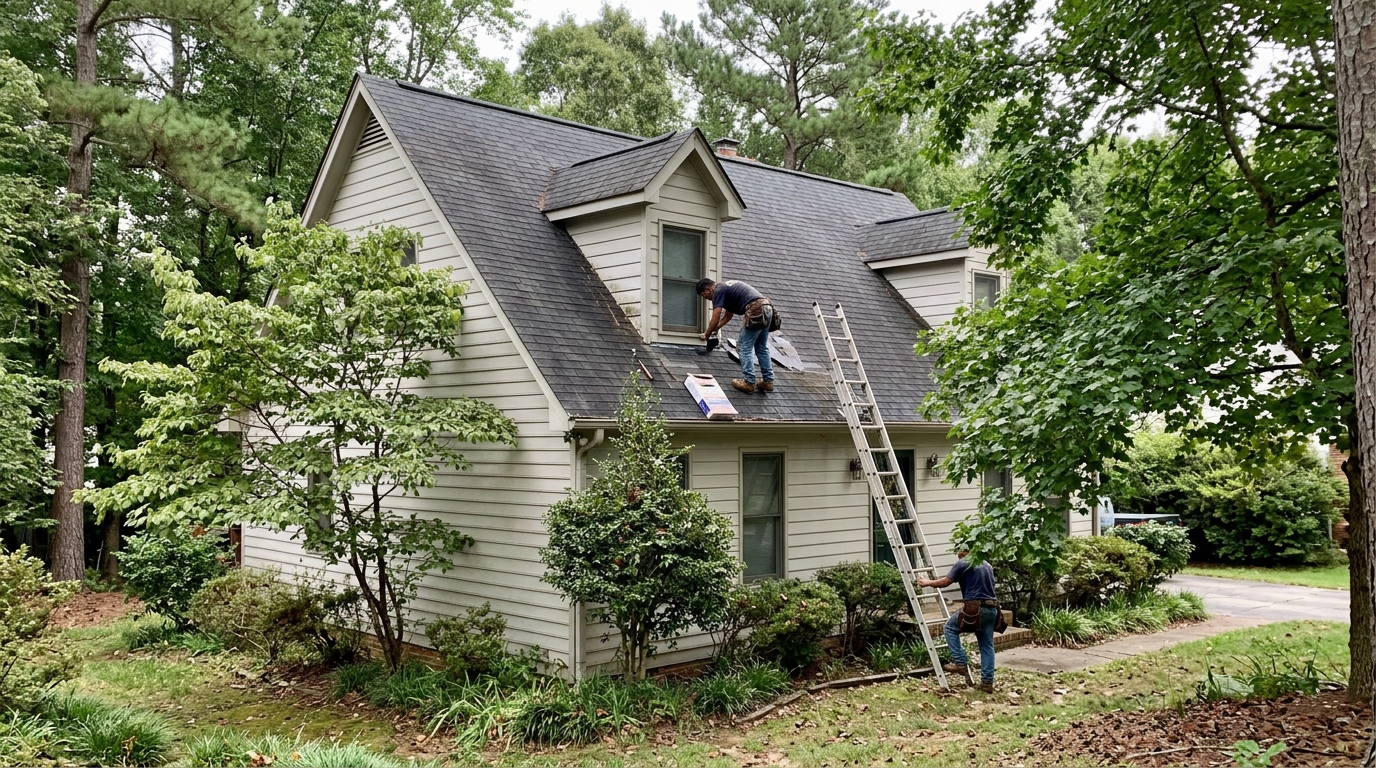
9 Signs You Need a Roof Replacement in North Carolina
Roofs rarely fail all at once. After more than 30 years of inspecting, repairing, and replacing roofs across central North Carolina — from Cary and Apex to Durham, Clayton, and Dunn — our team at MJ's Roofing and Remodeling can tell you that nearly every roof emergency we've been called to was preceded by warnings the homeowner missed or shrugged off. The difference between a minor shingle repair and a full roof replacement often comes down to recognizing the signs you need a roof replacement in North Carolina early enough to plan on your own terms.
This guide pulls together three decades of what we've learned working under North Carolina sun, wind, and humidity. You'll learn the nine warning signs that matter most, how to tell when repair still makes sense versus when replacement is the smarter investment, and a simple seasonal inspection routine any homeowner can follow. If you want a trained eye on your roof right away, our residential roofing services page explains how we handle everything from minor repairs to full tear-offs across the region.
Why North Carolina Roofs Age Faster Than You Might Expect
Shingle manufacturers rate their products for average conditions across the country. North Carolina is not average.
Our climate works on roofs from multiple directions at once. Summers deliver long stretches of intense heat and UV exposure that dry out asphalt shingles and break down their sealant strips. Atlantic hurricane season runs from June through November, and even storms that weaken before reaching us routinely drop heavy rain and damaging wind across the Piedmont and coastal plain. Add sudden pop-up thunderstorms in spring and summer, occasional hail, winter freeze-thaw cycles, and a pine pollen season that leaves its mark on everything outside, and your roof is fighting conditions most roofs elsewhere never face.
Humidity deserves special mention. Central and eastern North Carolina stay humid enough most of the year that algae streaks, moss patches, and attic moisture problems are far more common here than in drier regions — and all three quietly shorten a roof's useful life. That's why the age benchmarks you read online should be treated as a ceiling, not a promise, and why watching for the warning signs matters even more here than in most of the country.
The 9 Most Common Signs You Need a Roof Replacement in North Carolina
Some of these signs are visible from your driveway. Others only show up in the attic or the gutters. Use this as a checklist on your next walk around the house — the more items you check, the stronger the case that replacement, not another patch, is the right call.
1. Your Roof Is Nearing the End of Its Expected Lifespan
Standard three-tab asphalt shingles are generally expected to last around 20 years in favorable conditions, and thicker architectural shingles somewhat longer. In North Carolina, that timeline often runs shorter on south- and west-facing slopes that take the brunt of the summer sun. If your roof is in its late teens or older and showing any other symptom on this list, start planning rather than waiting. Replacing on your schedule — with time to compare materials and arrange financing — beats an emergency tear-off after a leak ruins a ceiling.
2. Curling, Cracking, or Clawing Shingles
Cupping shingles curl upward at the edges; clawing shingles pull in at the edges while the middle bulges. Both point to heat and moisture breaking down the shingle from the inside, and both leave the nail underneath exposed and the shingle ready to tear loose in the next wind. Cracking and splitting tend to follow as shingles flex through North Carolina's wide temperature swings. One curled shingle is a repair item. Curling across a whole slope is the roof telling you its time is up.
3. Granules Piling Up in Your Gutters
Those sandpaper-like granules on shingles are their sunscreen — they block the UV rays that would otherwise cook the asphalt underneath. Aging shingles shed granules steadily, and heavy thunderstorms flush them into your gutters where they collect like coarse sand. Look closely at any suspicious shingles: bald, dark patches where granule clusters have dropped away mean the shingle is decaying faster than it should, and the problem compounds every month the sun keeps shining.
4. Missing or Lifted Shingles After Storms
North Carolina weather is rough on shingle edges. A severe thunderstorm can pry loose a few tabs; a tropical system can strip entire slopes. A one-time storm loss on an otherwise healthy roof is usually a straightforward repair. But if you keep finding shingles in the yard after every gusty afternoon — or you've had the same slope patched two or three times in recent years — the sealant strips and the overall roof assembly are failing. At that point you're not chasing damage; the roof is aging out.
5. Water Stains, Leaks, or a Musty Attic
A brown ring on the ceiling is the obvious clue, but in our humid climate the attic often complains first. A musty smell, insulation that feels damp or has matted down, dark streaks on the roof sheathing, or rusted fasteners poking through the attic boards all point to moisture getting past the roof covering before it ever drips into a living space. And remember: water rarely appears directly below its entry point — it travels along the decking and rafters first. Recurring leaks in more than one area of the house are a strong signal the roof as a system is done, not that one spot slipped.
6. A Sagging Ridgeline or Wavy Roof Planes
Stand back on the street and study your roofline. Clean, straight lines are what you want to see. Dips along the ridge, a ridge that has lost its crisp peak, or roof planes that look wavy instead of flat suggest the decking underneath has been chronically wet and is losing structure. Spongy spots underfoot are another red flag — though we strongly discourage homeowners from walking suspect roofs; that's a job for professionals with the right equipment. Sagging almost never stays cosmetic. It needs a prompt professional evaluation, and it usually calls for replacement with at least partial decking repair.
7. Moss and Algae Taking Hold Across the Roof
Dark streaks on North Carolina roofs are typically algae, and on their own they're mostly cosmetic. Moss is a different story. It holds moisture against the shingle, works its way under the edges, and lifts them — a serious issue on a roof that is already aging or shaded by the big oaks and pines common in our neighborhoods. If moss keeps returning and the shingles beneath it are near the end of their lifespan, cleaning solves half of nothing. A new roof with modern algae-resistant shingles and better attic ventilation addresses the underlying cycle.
8. Daylight Where There Should Be None
On a sunny day, go into the attic and look up with the lights off. Thin beams of light between the roof boards and around chimneys or vent pipes are not normal. Small gaps let in wind-driven rain during exactly the kind of summer storms we get here, and they widen as fasteners back out and decking shifts with each freeze-thaw cycle. Pair daylight with nearby water stains and you have a confirmed entry point — and often one of several.
9. Energy Bills Creeping Up Without an Obvious Cause
A failing roof isn't just about water. Worn shingles and underlayment, combined with degraded attic ventilation, let your attic bake through North Carolina summers and hold heat and humidity well into the evening, forcing your air conditioner to work overtime. If summer energy costs have crept up while your household habits haven't changed, an aging roof with poor ventilation deserves a place on the suspect list. A properly replaced roof — with balanced intake and exhaust ventilation — often helps the whole house breathe easier.
Repair or Replace? How to Make the Right Call
Not every warning sign demands a new roof. The tricky — and expensive — part is knowing where the line sits. After three decades of inspecting roofs across the region, we use the framework below with homeowners.
| What You're Seeing | Repair Usually Makes Sense | Replacement Usually Makes Sense |
|---|---|---|
| Roof age | Under roughly 10 years, with damage confined to one area | Near or past its expected lifespan with multiple symptoms |
| Shingle condition | A handful of cracked or missing tabs | Curling, cracking, or granule loss spread across multiple slopes |
| Leak history | A first, traceable leak after an obvious cause | Recurring leaks in several spots or rooms |
| Roof deck | Solid underfoot everywhere | Soft spots, sagging, or visible decking deterioration |
| Repair history | Few or no previous patches | Patches layered on patches over recent years |
| Storm damage | A single well-documented weather event | Repeated seasonal losses and ongoing wind stress |
When a Repair Is the Smart Move
- The roof is young and the damage is genuinely isolated to a small area.
- Flashing around a chimney, vent, or skylight has worked loose — a common and fixable leak source.
- A documented storm event lifted or removed a limited number of shingles on an otherwise healthy roof.
- You need to bridge one or two seasons while you plan and budget for a full replacement on your schedule.
When Replacement Protects Your Home and Your Budget
- The roof is at or near the end of its expected lifespan, and multiple signs on the checklist are present.
- Repairs are becoming a routine line item rather than an occasional fix — those costs add up with nothing long-term to show for them.
- You plan to stay in the home, and you want modern materials, better ventilation, updated flashing details, and a fresh workmanship warranty.
- You're preparing the home for sale, where an aging roof becomes a negotiation problem far more expensive than the replacement itself.
Full replacement is a significant investment, and we believe it should never be a surprise. That's why our team walks you through a written assessment with photos, clear options on both sides of the repair-or-replace line, and financing options that let you spread the cost over time instead of forcing a single stressful decision. Good contractors give you information; great ones help you use it.
A Season-by-Season Roof Check for North Carolina Weather
You don't need to climb anything to catch most of these signs early. Build a quick routine around the way our seasons actually behave:
Spring: Storm Season Begins
Spring brings frequent thunderstorms and gusty fronts. After any storm with heavy wind, walk the perimeter of the house and scan the roof from the ground — binoculars help. Look for lifted shingle edges, new dark streaks, and debris. This is also the season to confirm your gutters are catching water cleanly rather than overflowing over the roof edge, where repeated spillage soaks the fascia and the roof's lower edge.
Summer Through Fall: Hurricane Season Vigilance
The Atlantic hurricane season runs from June 1 through the end of November, and inland North Carolina regularly takes damaging rain and wind from systems that make landfall along the coast. After each significant storm, take dated photos of your roof from a few vantage points. That habit pays twice: it helps you spot changes early, and it creates the documentation homeowners need if damage turns into an insurance conversation later.
Winter: Freeze-Thaw and Quiet Worsening
North Carolina winters swing between mild afternoons and hard freezes. Those cycles widen every small crack and lift nail pops that sat dormant in the fall. Check the roofline after cold snaps, watch for loose ridge shingles, and use the quieter season to schedule an inspection so any work happens before the spring storm machinery starts up again. Keeping pine needles and leaf debris off the roof and out of the valleys year-round is quietly one of the highest-value habits a homeowner in this region can build.
What a Professional Roof Inspection Should Cover
DIY checks catch the obvious. A professional inspection measures everything that decides whether your roof has another five years or another five months left in it. Ours includes:
- A shingle-by-shingle evaluation of every slope, including sealant strips and fasteners
- Flashing, boots, and joints at chimneys, vents, skylights, and wall transitions — the most common leak points in the trade
- Attic checks for stains, daylight, insulation condition, and the moisture and ventilation issues that thrive in our climate
- Ridge, valley, and edge conditions, plus gutters and drainage paths
- Photos and a written lifespan estimate, with both repair and replacement options laid out honestly
One more thing worth saying plainly: an honest contractor will tell you when a repair will serve you just fine. We've built a three-decade reputation in communities from Chapel Hill to Benson by never selling a replacement to a homeowner who didn't need one. That reputation is the most valuable thing we own besides our tools.
Frequently Asked Questions About Roof Replacement in North Carolina
How long does a roof last in North Carolina?
Standard asphalt shingles are typically expected to last about 20 years in favorable conditions, with architectural shingles rated longer — but our heat, humidity, and storm exposure frequently shorten the practical life, especially on sun-heavy south and west slopes. We generally recommend a professional look every couple of years once a roof passes its mid-teens, and annually once it is past the 20-year mark or has survived major storm seasons.
Will homeowners insurance cover a roof replacement?
It depends on the cause and on your policy. Sudden, weather-driven damage — wind, hail, a fallen limb — is often covered, while gradual wear and age typically is not, and many North Carolina carriers have tightened how they treat older roofs. Dated photos and inspection reports go a long way in that process. We help homeowners document conditions and understand their options, though the final call always rests with your insurer and your policy language.
What is the best time of year to replace a roof in NC?
Spring and fall are popular for their moderate temperatures, but an experienced local crew can install a roof safely through most of the year in our climate. The scheduling reality is different: after an active storm season, quality contractors' calendars fill quickly. If your roof is already leaking, waiting months for a prettier weather window risks real interior damage — the right time to replace a failing roof is when the signs tell you it's time.
Can I replace only part of my roof?
Occasionally, when damage is genuinely isolated to one section of an otherwise healthy roof. More often, it creates a visible mismatch, because aged shingles have faded and weathered differently from new ones, and the old sections keep aging at their own pace. Partial replacement can be a legitimate tool after a single storm event — but as a cost-saving strategy on an aging roof, it usually just splits the same total cost into two inconvenient projects.
How can I tell storm damage from normal aging?
Timing and pattern are the keys. Storm damage tends to appear suddenly — fresh dark bruise marks, creased or torn shingles, and missing tabs that line up with a specific weather date — while aging shows up as gradual, uniform curling and granule loss across the whole roof. Both matter, but they lead to different paths: one is often an insurance conversation, the other a planning-and-budgeting conversation. Our inspections document which is which so you're never guessing.
The Bottom Line for North Carolina Homeowners
Watch for patterns, not panic. The true signs you need a roof replacement in North Carolina rarely announce themselves with a dramatic leak — they show up as age plus two or three of the checklist items above: granules in the gutters, curling edges on the hot slope, musty air in the attic, shingles in the yard after every windy Saturday. Catch them early and you get to replace your roof on your terms, with the right materials, the right budget, and no soaked ceilings.
For more than 30 years, MJ's Roofing and Remodeling has protected homes across Apex, Cary, Durham, Clayton, Dunn, and the surrounding communities with quality craftsmanship and straight answers about when to repair and when to replace. If your roof checked any of the boxes above, don't wait for the next storm to make the decision for you — schedule your roof inspection today and we'll give you an honest, photo-documented assessment of exactly what your roof needs. No more, and no less.