
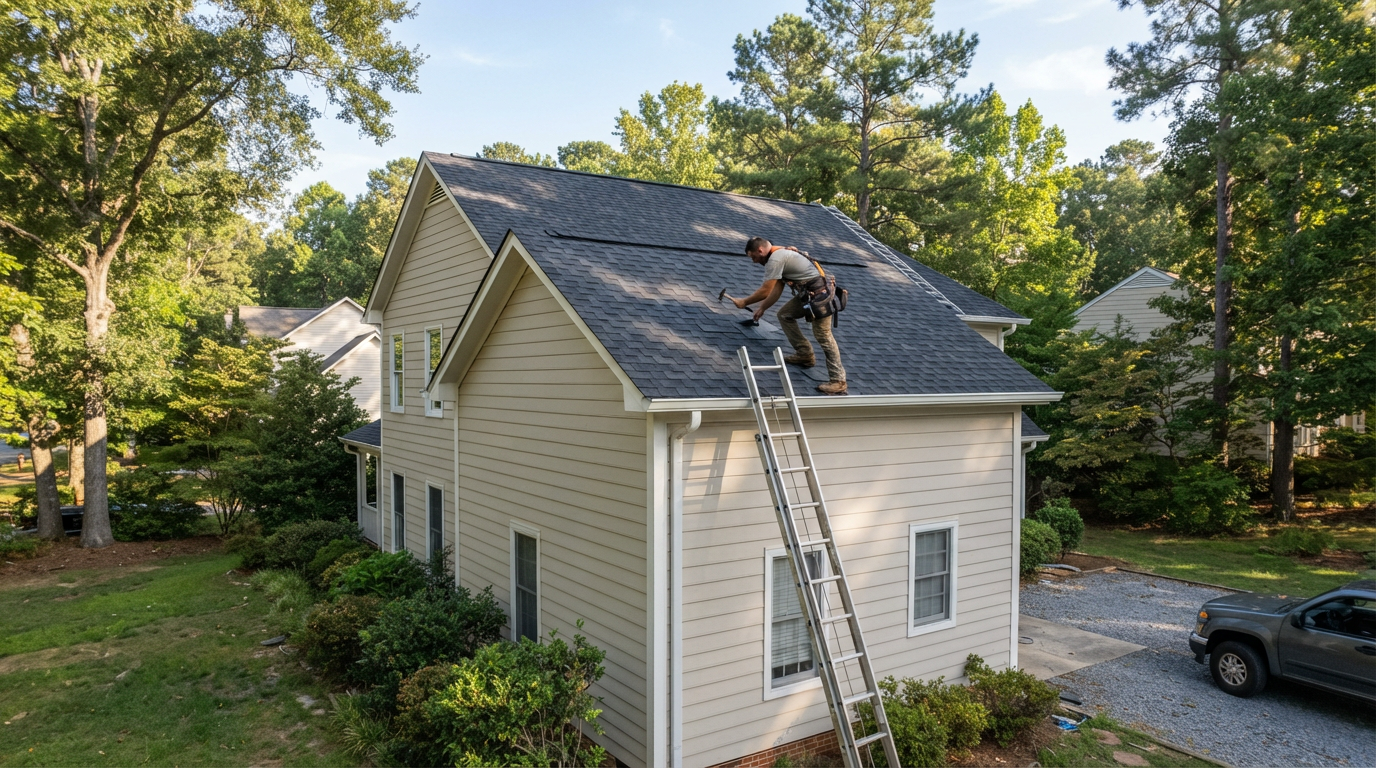
9 Signs Your Roof Needs to Be Replaced: NC Homeowner's Guide
For more than 30 years, the crews at MJ's Roofing and Remodeling have climbed across rooftops in Apex, Cary, Durham, Clayton, Dunn, and communities throughout central North Carolina — often right after hail storms, straight-line winds, and the slow, relentless heat of a Carolina summer. If three decades in this trade has taught us anything, it is this: roofs almost never fail without warning. They send signals for months, sometimes years, before the first drip ever reaches your ceiling.
Learning to recognize the signs your roof needs to be replaced is one of the most financially valuable skills a North Carolina homeowner can develop. Catch those signals early and you can plan a replacement on your schedule and your budget. Miss them, and the roof picks the timing for you — usually during the next big storm, at emergency prices. This guide walks through the warning signs we check on every inspection, a safe method to assess your own roof, and a straightforward framework for deciding between repair and replacement.
Why “Wait and See” Is the Most Expensive Roofing Strategy
Water is patient. A shingle that lifted during last spring's storm does not fix itself — it curls a little further each summer, lets a little more moisture reach the underlayment, and slowly compromises the wood decking beneath it. By the time a stain appears on your ceiling, moisture has typically already passed through three layers of your roofing system, and damage inside the attic rarely stays contained to the attic.
We have met plenty of homeowners who paid for drywall repair, insulation replacement, and even mold remediation for problems that a small, timely repair would have stopped years earlier. Reading your roof's warning signs early is not about panic — it is about keeping your options, and your money, where they belong.
The 9 Signs Your Roof Needs to Be Replaced
No single symptom automatically condemns a roof. Professionals look at the whole picture: age, material, repair history, and the pattern of damage. That said, these are the signals we take most seriously on residential roofs across our region.
1. Your Roof Is Approaching the End of Its Lifespan
Age is the single best predictor of roof health. Standard three-tab asphalt shingles are generally expected to last around 20 years, while architectural shingles typically deliver 25–30 years under favorable conditions. North Carolina works against those numbers more than homeowners expect: intense UV exposure, repeated heat-and-thunderstorm thermal cycling, humidity, and constant debris from our pine trees all accelerate shingle aging.
If your roof is in its early twenties and you cannot document its history, it is already in its decision window. Not sure how old it is? Ask the previous owner, check closing paperwork for permit records, or look for the manufacturer's date stamp printed on the shingle tabs visible in your attic.
2. Curling, Cracking, or Clawing Shingles
When shingle edges curl upward or the centers claw downward, the asphalt mat has begun losing its flexibility — a process baked in from years of sun on top and attic heat from below. Cracked shingles are the next stage: brittle tabs that snap along the bond line and shear off in wind. A handful of curled shingles can be patched. When curling appears across broad sections of the roof, the material has aged out as a system, and an honest roofer will tell you so.
3. Bald Spots and Granule Piles in Your Gutters
Those sandpaper-like granules are not decoration — they are the shingle's UV armor. As a shingle nears the end of its life, the granules let go, leaving dark “bald” patches and filling gutters and splash areas with coarse black sand. Significant granule loss means every remaining storm strips away more protection. If you are already paying attention to what your gutters collect, our gutter installation and gutter guard services can keep debris moving where it should — and make the true condition of your shingles easier to read.
4. Missing, Torn, or Creased Shingles After Storms
Central North Carolina gets no shortage of wind: summer thunderstorms, tropical system remnants, and the occasional severe outbreak. A few missing tabs after a blow is a repair conversation. But when shingles come off in repeating patterns down a slope, or when creases show where material flipped in the wind, that tells us the sealant strips across the whole roof have weakened — a classic case where full replacement is the economically responsible repair.
5. Water Stains, Active Leaks, or Daylight in the Attic
Grab a flashlight and visit your attic on a bright day. You are looking for three things: daylight streaming through the roof boards, dark streaks or stains on the decking and rafters, and compressed or damp insulation. Remember that water travels along framing long before it shows itself, so a hallway ceiling stain may originate two rooms away on the roof. Any active leak on a roof older than 15 years should prompt a professional evaluation — not another bucket in the corner.
6. A Sagging or Uneven Roofline
Stand back at the curb and sight along the ridges and planes of your roof. A dip in a ridge, a wave in a plane, or a soft sag between rafters points to moisture-weakened decking or structural members under strain. This is the one sign on our list we treat with real urgency: sagging indicates the structure itself is compromised, and it should be evaluated by a professional promptly, not monitored for another season.
7. Moss, Algae, and Rot That Keep Coming Back
Our humidity makes North Carolina roofs a friendly environment for algae streaks and moss patches. Algae staining is largely cosmetic, but moss holds moisture against the shingle surface and works its way underneath, lifting tabs and accelerating decay. Widespread moss — especially when shingles lift when gently probed — is a replacement signal, because cleaning it off will not restore shingles that are already absorbing water.
8. Rising Energy Bills and Rooms That Won't Stay Comfortable
A worn roof combined with tired attic ventilation lets our brutal July heat radiate down into the living space, and your HVAC pays the difference. Homeowners are often surprised how frequently roof replacement and ventilation corrections coincide with noticeably more comfortable upstairs rooms. If your roof is aging and cooling costs keep climbing year after year with no other explanation, the building envelope is a prime suspect.
9. Your Neighbors Are Replacing Their Roofs
This one sounds informal, but it is genuinely one of the most reliable tools in our trade. Homes in the same subdivision were usually roofed within a few years of each other with the same materials, so they age together. When several neighbors on your street — particularly those with the same builder and shingle profile — have replaced recently, your roof is very likely in the same window. Let it be an early prompt to schedule an inspection before the shingles announce it for you.
A Safe 15-Minute Roof Check Any Homeowner Can Do
You do not need a ladder to gather most of the evidence a professional will ask about — in fact, we would prefer you keep both feet on the ground. Roof inspections are our job, not yours. Here is the simple process we recommend:
- Scan from the ground. Walk the perimeter with a pair of binoculars. Look for missing or curled shingles, dark patches, sagging lines, and damaged flashing around chimneys, vents, and skylights.
- Check the gutters and splash areas. Heavy granule buildup or shingle fragments at downspout exits tell you the surface is shedding its protection.
- Visit the attic. Look for daylight, water staining on the decking, damp insulation, and musty odors.
- Inspect top-floor ceilings and walls. Brown rings, peeling paint near the ceiling line, or stains that reappear after rain all point back up to the roof.
- Document everything. Photograph what you find with your phone and note the dates. A simple photo history makes any future insurance conversation or contractor estimate dramatically easier.
If steps one through four turn up anything beyond routine aging, it is time to bring in an experienced set of eyes. Our team handles everything from targeted repairs to complete residential roofing replacement, and a proper inspection costs you nothing but an hour of your time.
Repair or Replace? A Decision Framework That Removes the Guesswork
Once the warning signs appear, the real question becomes: patch it, or replace it? A repair is always worth considering first — but only when the math and the material both agree. This is the decision matrix we walk through with homeowners:
| Factor | Lean Toward Repair | Lean Toward Replacement |
|---|---|---|
| Roof age | Under roughly 10–12 years | Approaching or past its expected lifespan |
| Damage pattern | A handful of isolated shingles or one small section | Widespread curling, cracking, or shedding across slopes |
| Leak history | One isolated leak, promptly contained | Recurring leaks or stains in multiple rooms |
| Decking condition | Sound and dry in the attic | Soft, spongy, or visibly water-stained decking |
| Repair history | First issue in recent years | Second or third repair in a short span, with new symptoms appearing |
A long-standing rule of thumb in our trade: when a repair's cost starts climbing toward roughly half the price of replacement, or when the damage is systemic rather than isolated, replacement becomes the better long-term investment. Repeatedly patching an aging roof is like putting new tires on a car that needs a transmission — the underlying system is what actually decides your costs.
The Case for Replacing Proactively
- A complete waterproofing system. New underlayment, flashing, ventilation, and shingles designed to work together — not one old material working alone.
- Warranty protection. Manufacturer coverage on new materials backed by documented workmanship, versus repairs with far narrower guarantees.
- Better summer performance. Modern shingle technology and corrected attic ventilation can meaningfully ease heat load in our climate.
- Resale confidence. A documented recent roof is one of the first things buyers and inspectors look for.
The Honest Tradeoffs
- Higher upfront cost than a repair. Financing options can spread the investment over time for qualified homeowners.
- A multi-day project. Most replacements take days rather than hours — though a proper crew protects your landscaping, your property, and cleans up thoroughly when the work is done.
What a Proper Roof Evaluation Should Include
Whoever inspects your roof — us or anyone else — should do considerably more than glance at shingles from a ladder. A thorough evaluation includes an interior attic check, an exterior walk of every slope, a flashing and penetration inspection, a ventilation assessment, and a decking condition check, followed by photos and a written explanation of what was found. You should receive both a repair option and a replacement option, with an honest recommendation tied to your roof's age and damage pattern, before anyone talks numbers.
And beware of anyone who pushes a same-day decision or cannot explain why they recommend what they recommend. The signs your roof needs to be replaced rarely arrive one at a time, and good roofing decisions are made with information — not pressure.
Roof Replacement FAQs from North Carolina Homeowners
How long should an asphalt shingle roof last in North Carolina?
Three-tab shingles are commonly expected to last around 20 years, with architectural shingles typically reaching 25–30 years. Our region's heat, humidity, and storm activity often place local roofs at the lower-to-middle of those ranges, especially when attic ventilation is poor. Treat any roof in its late teens as entering its evaluation window.
Does a single leaking roof always mean full replacement?
No. An isolated penetration or a small wind-lifted section on a younger roof is often repairable. Age changes the equation: on a roof well into its lifespan, one leak is frequently the first visible symptom of broader wear, which is why a full inspection — not just a patch quote — matters.
When is the best time of year to replace a roof in NC?
Spring and fall offer the mildest working conditions, but reputable crews replace roofs year-round in our climate; summer scheduling simply builds in heat precautions. If your roof is actively failing, do not wait for a “perfect month” — delaying usually costs far more than the weather ever will.
How long does a full roof replacement take?
Most single-family homes are completed in a few working days, depending on size, roof pitch, how many old layers must be removed, and whether decking needs repair. Larger or more complex roofs take longer. A well-run crew protects your property during the work and leaves the site clean, with a magnetic sweep for nails.
What should I do first if I think my roof is failing?
Document what you can from the ground and from the attic, contain any interior water, stay off the roof, and schedule a professional inspection promptly. Early documentation protects both your budget and any future insurance claim, and an inspection will tell you whether you are facing a repair or a replacement.
Protect Your Home Before the Next Storm Does
Every item in this guide tells the same story in a different way: the protective layer over your family is wearing out. Curling shingles, granules filling your gutters, a stain creeping across a ceiling — these are not annoyances to watch indefinitely. They are your roof telling you the work ahead's timing, and you get to decide whether to hear it now or during the next severe weather event.
At MJ's Roofing and Remodeling, roofing is not a side business — it is the heart of what we have done for more than 30 years across North Carolina, with quality craftsmanship and service we would want on our own homes. If you recognized any of the signs your roof needs to be replaced, the simplest next step is a professional look. Schedule your free roof inspection online and get a clear, pressure-free answer about what your roof needs — repair, replacement, or simply a few more good years.