
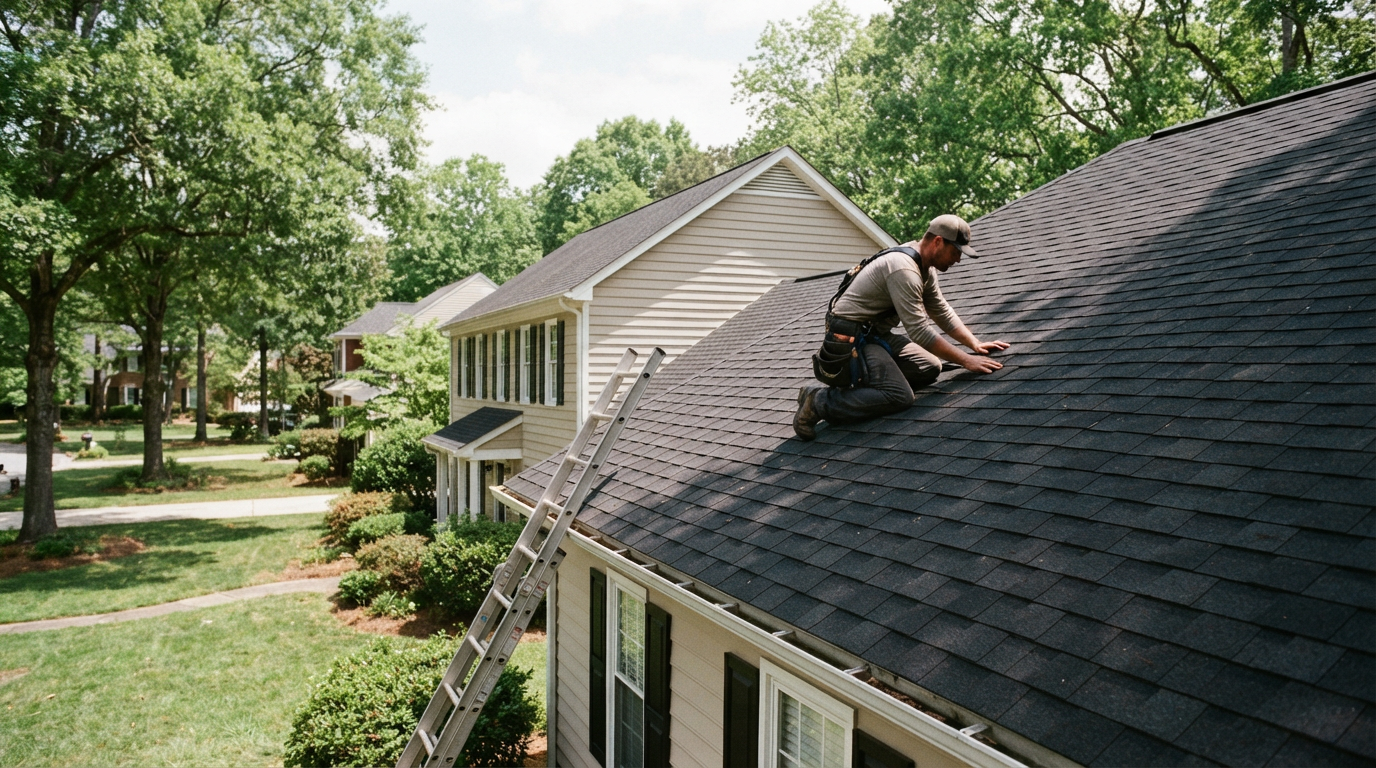
How to Spot Hail Damage on Your North Carolina Roof: A Guide
Why Hail Damage Is a Serious Concern for North Carolina Homeowners
North Carolina gets more than its share of hail. Every spring and summer, severe thunderstorms sweep across the Piedmont, the Triangle, and the Sandhills, and when those storms turn intense, hailstones usually come with them. After more than three decades of inspecting and repairing storm-damaged roofs across central North Carolina, our team at MJ's Roofing & Remodeling has learned a hard truth: the most expensive hail damage is often the kind you cannot see from the driveway — and the costliest mistake a homeowner can make is assuming everything is fine simply because there is no leak in the ceiling.
Hidden hail damage rarely announces itself right away. A bruised shingle can keep water out for months before it fails, and by the time the leak appears, rot and interior stains have already started. This guide walks you through how to spot hail damage on your North Carolina roof the way a professional inspector would — safely, systematically, and without climbing a ladder unless you absolutely need to.
How to Spot Hail Damage on Your North Carolina Roof: Begin at Ground Level
Roofing professionals never start on the roof. We start on the ground, because a hailstorm leaves evidence all over your property, not just on your shingles. If hail was large enough to bruise a roof, it almost always left calling cards on softer materials nearby. This ground-level pass costs you nothing, takes fifteen minutes, and tells you whether a closer look is warranted.
Step 1: Survey Your Surroundings First
Walk your property slowly and look for damage on anything softer or more exposed than your shingles. Hail that can bruise an asphalt shingle will dent, tear, or chip many of these materials:
- Window screens and vinyl window frames — small tears, punctures, or cracks on the storm-facing side of the house
- Vehicles left outside — dimpled hoods, roofs, and trunk lids
- Air conditioning condenser fins — thin aluminum fins that bend easily under hail impact
- Siding and shutters — dents, chips, or cracks concentrated on one side of the home
- Wooden decks, fences, and lawn furniture — fresh gouges or dents in soft wood
Pay special attention to which side of the house shows damage. Hail usually travels with the wind, so impacts cluster on one exposure. If everything on the southwest side of your property is dented and everything on the northeast side is clean, that directional pattern is a strong clue that your roof's windward slope took the brunt of the storm too.
Step 2: Check the Soft Metals — Flashing, Vents, and Fascia
Insurance adjusters often begin their inspections here, and you should too. Metal components on and around your roof record hail impacts almost like a notepad:
- Roof vents and pipe collars — small, shallow dents on the metal housing
- Valley flashing and drip edge — irregular dings along the metal strips
- Aluminum fascia and gutter aprons — depressions you can feel with your fingertips
- Chimney caps and skylight frames — pockmarks on flat metal surfaces
Random, scattered dents on these metals — not parallel lines, not uniform rows — point to true hail impact rather than manufacturing texture or ordinary wear. Fresh dings here are one of the clearest signals that hail reached your roof level.
Step 3: Inspect Gutters, Downspouts, and What They Are Catching
Your gutter system is both a damage indicator and an evidence collector. Dents along the face of the gutters or downspouts suggest hail big enough to matter. Then look inside: if the storm knocked granules loose from your asphalt shingles, you will often find a gritty, sand-like accumulation of dark material in the gutters and at the base of the downspouts within days of the storm. That granule sand is your roof's built-in UV protection — and every shingle it washed from just lost part of its service life.
While you are at it, confirm that gutters and downspouts still drain properly. Hail-damaged gutters that sag, pull away from the fascia, or overflow in heavy rain will channel water against an already-weakened roof edge, so they deserve evaluation alongside the roof itself.
Your Ground-Level Storm Checklist at a Glance
| Where You Look | What You Find | What It Suggests |
|---|---|---|
| Screens, cars, AC fins | Dents or tears clustered on one side | Directional hail impact — the same wind likely drove hail onto one roof slope |
| Vents, flashing, fascia | Random dents in soft metal | Hailstones likely reached roof level; shingles need closer inspection |
| Gutters and downspouts | Dents plus dark granule sand | Active granule loss from the shingles — schedule a professional inspection |
| Siding and shutters | Chips or cracks on the storm-facing side | A severe storm; collateral roof damage is likely |
| Everything | Clean, undamaged surfaces | Lower-risk outcome — monitor after the next storm |
What Hail Damage Actually Looks Like by Roofing Material
Ground-level clues build your case, but confirming roof damage means knowing how hail treats each material differently. Here is what our inspectors look for on the most common roof types in North Carolina.
Asphalt Shingles — The Most Common Signs of Hail Damage on Your North Carolina Roof
Most homes from Apex and Cary eastward wear asphalt shingles, and hail leaves three signature marks on them:
Bruised Shingles
A hail bruise is like a bruise on an apple — a soft, spongy dimple where the granules were crushed into the mat beneath. The surface may look intact, but that compressed spot eventually dries out, cracks, and admits water. Bruising is rarely visible from the ground, which is exactly why the ground checklist matters so much: it tells you when to trust a professional's hands-on examination.
Concentrated Granule Loss
Hail knocks granules out in discrete, circular spots roughly the size of the hailstone — commonly dime- to quarter-sized — exposing the black asphalt mat below. This looks nothing like the broad, even thinning of an aging roof. Freshly exposed mat is also darker and shinier than the surrounding weathered surface, which helps date the damage to a recent storm.
Cracked or Fractured Shingle Mats
When larger hail strikes older, sun-baked shingles, it can crack the mat inside the shingle. From a distance the shingle looks fine; up close there is a fracture line, or the underside shows a bruise ring. This is the damage that hides for a season and then becomes a ceiling stain — and it is nearly impossible to confirm without a hands-on inspection.
Metal Roofing
Standing seam and metal panel roofs tell the story plainly: look for dents and dimples on the flat pans, especially along ribs and ridges where hailstones land squarely. Many dents are cosmetic, but heavy hail can split seams, work fasteners loose, or crack coatings at the dimple, so a post-storm inspection is still worthwhile.
Wood Shakes and Clay or Concrete Tile
Hail splits cedar shakes along the grain, leaving sharp-edged splits with bright, unweathered wood inside — very different from the soft, cupped cracking of age. On tile roofs, watch for chips, corner breaks, and cracked profiles. Even a single cracked tile can funnel water onto the underlayment beneath, so small breaks deserve attention.
Hail Damage or Normal Wear? Do Not Misread the Signs
Some of the most common misdiagnoses we see come from homeowners confusing routine aging with storm damage — and mislabeling the two can get a legitimate insurance claim denied. This comparison keeps the two straight:
| Characteristic | Hail Damage | Normal Wear and Tear |
|---|---|---|
| Pattern | Random, scattered hits and clusters | Uniform across the whole roof |
| Direction | Concentrated on the slope facing the storm | Equal on every slope, front and back |
| Granule loss | Sharp circular spots exposing black mat | Gradual, even dulling with no defined circles |
| Timing | Appears right after a documented storm | Develops gradually over many years |
| Soft metals | Fresh dents on vents, flashing, gutters | No corresponding dents |
| Surrounding property | Screens, siding, and vehicles all hit at once | Only the roof shows aging |
One caution: blisters, curling, and algae streaking on older shingles can look superficially like hail marks to an untrained eye. When you are unsure, have our residential roofing specialists make the call — accurate documentation is most of the battle.
DIY Walkaround vs. Professional Inspection
Both have a place in the process. We encourage every homeowner to do the ground-level pass — and we discourage nearly every homeowner from crawling on a roof right after a storm.
The Ground-Level Walkaround
Pros: free, safe, and immediate; builds your documentation; tells you whether a professional visit is needed.
Cons: cannot verify bruised mats or hidden fractures, since shingle bruising is rarely visible without close, hands-on examination.
The Professional Inspection
Pros: trained eyes catch functional damage you will miss; safe roof access; written findings and photographs you can hand directly to your insurance company; honest guidance on repair versus replacement.
Cons: requires scheduling — which is exactly why you should get on the calendar right after a storm, before local crews fill up. Our service covers dozens of communities across the region; you can confirm your town on our areas we serve page.
The 5-Step Action Plan After a Hailstorm
- Document everything within the first few days. Photograph dented metals, damaged screens, downspout granules, and any shingle marks you can safely see, and note the date of the storm. Insurance claims live and die on documentation.
- Keep minor damage from becoming major. If you spot an active problem — a loosened shingle, a leaking skylight, a detached downspout — address it quickly to keep water out of the structure while the bigger decisions get made.
- Schedule a professional inspection. A qualified local roofer will examine the shingles up close, mark suspected hits, and tell you plainly whether the roof sustained functional damage. Reputable contractors do this honestly, because an inflated claim helps no one.
- Review your policy and talk to your insurer — carefully. Most homeowner's policies cover sudden storm damage, but they also set deadlines for filing and may pay out differently depending on how your roof is covered. Know your timeline, and lean on your contractor's documentation to support the claim.
- Repair or replace with a contractor you have vetted. Choose a company with a local track record, ask about manufacturer certifications and workmanship warranties, and get everything in writing before you sign.
Five Mistakes to Avoid After Hail Hits
- Climbing on the roof yourself. Wet shingles are slick, storm-weakened structures can be fragile, and ladder falls injure far more homeowners than roof leaks ever do.
- Signing with a door-knocking crew the day after the storm. Out-of-town storm chasers appear after every big weather event, finish fast, and vanish before warranty issues surface. Insist on a contractor rooted in your community.
- Waiting months to act. Damage does not improve with time, and insurers may question delayed discovery, which complicates the claim.
- Patching without diagnosing. A spot repair over hidden bruising simply relocates the leak.
- Assuming no leak means no damage. Hail damage is frequently latent — the leak arrives later, sometimes a season or more after the storm.
The Local Advantage When Hail Strikes
Storm-chasing contractors know the forecast, but they do not know your neighborhood. A hail inspection done right accounts for North Carolina specifics: the architectural shingles common across the Triangle, the steep-slope details on older farmhouses east of town, the wind-direction patterns of our spring squall lines. After 30 years of roofing from Chapel Hill to Angier, we know what hail typically does to homes like yours — because we have repaired the results, storm after storm.
We are also here after the invoice. Roofing is a relationship business: the crew that inspects your roof this month should still answer the phone five years from now. That kind of permanence — not a discounted one-time contract — is what actually protects a home.
Frequently Asked Questions About Hail Damage on North Carolina Roofs
What size hail actually damages a roof?
As a general rule of thumb, hailstones around one inch in diameter — roughly the size of a quarter — are considered capable of damaging asphalt shingles, particularly on older roofs baked by years of Carolina sun. Smaller stones can still bruise weathered shingles or dent soft metals, and wind matters too: hail driven sideways at highway speed hits harder than calm, vertical hail. Treat any significant hail event as a prompt to run your checklist.
Can hail damage exist even if the roof looks fine from the ground?
Yes — and this is precisely why the ground-level checklist matters. Bruised or fractured shingles usually cannot be confirmed from the yard. If the storm dented your vents, flashing, gutters, siding, or the car in the driveway, the shingles on the storm-facing slope deserve a professional, hands-on examination even if the roofline looks perfect.
Will my homeowner's insurance cover hail damage?
Homeowner's policies in North Carolina typically cover sudden storm-related damage, including hail. What varies are your deductible, whether the policy settles based on actual cash value or full replacement cost, and the claim-filing deadline your insurer sets. Before filing, put documentation in hand — dated photos plus a professional inspection report — and ask your agent exactly how your roof is covered.
How soon after a storm should I get my roof inspected?
Sooner is better. A prompt inspection ties the damage clearly to the storm date, gets you in line before local schedules fill up, and leaves time to mitigate anything urgent. Ideally, have a professional on the roof within days to a couple of weeks — and use the meantime for your documentation photos and ground-level checks.
Should I repair or fully replace a hail-damaged roof?
It depends on the extent of the damage and the age of the roof. Widespread bruising across multiple slopes, fractured shingle mats, or an older roof with heavy granule loss usually points toward replacement, which restores full protection and simplifies the insurance conversation. A limited number of broken shingles may call for targeted repair. Either decision should come from an inspection that documents the roof's actual condition — not a guess made from the curb.
Protect Your Roof Before the Next Storm Rolls In
Knowing how to spot hail damage on your North Carolina roof puts you ahead of most homeowners — but spotting it is only half the job. The other half is having a trusted local crew confirm what you are seeing, document it properly, and see the repair or replacement through from start to finish.
At MJ's Roofing & Remodeling, we have spent three decades protecting North Carolina homes with quality craftsmanship and straight answers. If a recent storm has you questioning your roof — or you simply want peace of mind before the next severe weather season — schedule your free roof inspection with our team. We will walk you through exactly what we find, document everything thoroughly, and tell you plainly whether repair, replacement, or nothing at all makes sense. No pressure, no guesswork — just decades of local expertise keeping your home protected.